Systems | Development | Analytics | API | Testing

Latest posts

What are Virtual Users (VUs) in Load Testing? Definition + Examples

Virtual users (VUs) are the simulated humans that hit your system during a load test. They’re the load. Where real users come from browsers and apps, VUs come from a test harness. JMeter threads, k6 worker goroutines, Locust greenlets. Each VU sends requests, waits for responses, sometimes pauses (“think time”), and repeats. Aggregate enough VUs and you get traffic that looks like a real audience.

Ep 75 | Why Enterprise AI Still Breaks at Scale with Ravit Jain

As organizations rush to scale AI, many are learning that better models can’t compensate for weak data foundations. AI hype is everywhere, but operational readiness still isn’t. In this episode of The AI Forecast, Paul Muller sits down with Ravit Jain, founder of The Ravit Show and one of the leading voices in the global data and AI community, to explore the trends shaping the future of enterprise AI.

Customer Data Ingestion at Scale for B2B Platforms

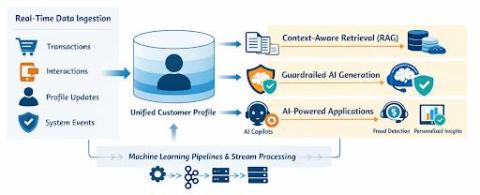
Customer data ingestion is the process of collecting customer records from CRM, ERP, product, support, and file-based sources, validating them, and routing them into the systems that power onboarding, reporting, and activation. For B2B platforms, a good approach is a tenant-safe pipeline that can land history, sync ongoing changes, and deliver trusted records quickly.


Simplifying Modernization with Flexible Acquisition Options

Modern infrastructure transformation should accelerate innovation — not add complexity. As organizations modernize to support mission-critical workloads, hybrid architectures, AI data activation, and third-party environments, they need flexibility, visibility, and trust. That’s why Hitachi Vantara is simplifying infrastructure acquisition and management by delivering an outcome-driven experience for the data center.

Kong: # Building AI Chargeback: From Metering to Billing

Your AI platform is running. Teams are using it. Someone from Finance just asked how much each team is actually spending and you don't have a clean answer. That's the chargeback problem. It sounds like a billing question, but it's really an infrastructure question. Token consumption, model selection, request volume, latency tiers. None of that maps cleanly to a cost center without the right plumbing in place.

Is WebSockets enough for AI chat?

WebSockets are the right protocol for production AI chat. But that fact doesn’t prevent the failure most teams hit first. An enterprise load balancer closes the idle connection at 60 seconds during a tool execution wait. Your reconnect logic fires in under a second, the agent keeps running server-side, and the client receives nothing from the gap. No tokens, no tool call results, no context. The reconnected socket has no view of what happened while it was down.

How to Add Your First Streaming Transformation with Flink

A streaming transformation is a continuous operation that processes events as they arrive, applies logic in real time, and emits transformed results immediately—without waiting for batch jobs to complete. In Apache Flink, a streaming transformation runs continuously, reacting to each event from a stream. This enables real-time data transformation directly on live data.

Instant Java Client SDK, no spec required!

Learn how to generate a client SDK for a production service when you have no documentation, no OpenAPI spec, and no remaining team knowledge of the original Ruby code. This demo shows you how to capture real production data from a running app and transform it into a functional Java client library in minutes. Visit proxymock.io OR speedscale.com to learn more.

SAP Sapphire 2026 highlights: Quality for the "Autonomous Enterprise"

The 2027 S/4HANA deadline still looms large in the minds of SAP customers, but at this year’s SAP Sapphire event, SAP worked to move the conversation beyond cloud migration alone. Instead, they introduced a broader redefinition of what it means to be an “Autonomous Enterprise.” At the center of this new Autonomous Enterprise strategy is agentic AI. SAP envisions the future enterprise as one that can leverage its business data to power agents across its ERP applications.