
Top 5 IPv4 Marketplace & Auction Platforms Compared (2026)

Image Source: depositphotos.com
Your network team has found a /24 that looks right. The quote shows a price per address and little else. It doesn't confirm that your organization qualifies to receive the block, that your cloud provider will accept it, or what happens to your payment if the registry transfer stalls.
That gap is why the platform you buy through matters as much as the price. Some run auctions, some sell at fixed prices, some broker private deals and some lease addresses instead. This guide compares five IPv4 marketplace and auction platforms, then walks through how to buy IPv4 address blocks from eligibility to production.
Buying vs Leasing IPv4
A purchase transfers the registration to your organization through the regional internet registry (RIR). A lease gives you contractual use of addresses that stay registered to someone else.
- Buy when the addresses will support services for years and you want the registration under your control. You take on the purchase price, annual registry fees and record administration.
- Lease for temporary capacity, such as a migration or a short project. Compare the full lease term and renewal conditions against the purchase cost.
Either way, check whether some demand can move to IPv6 or be absorbed by NAT or shared front ends, so you only buy the capacity you'll use.
Quick Comparison
|
Platform |
Model |
Pricing approach |
Block checks |
|
IPv4 Connect |
Fixed-price marketplace, no auction |
Buy-now pricing; free sign-up |
Free blacklist report on every subnet |
|
IPv4.Global |
Marketplace plus private transactions |
Buyer fee of $1 per address, $500 minimum |
Varies by listing |
|
IPXO |
Leasing marketplace |
Platform subscription priced separately from lease charges |
Varies by listing |
|
Prefixx |
Brokerage |
No buyer brokerage fee; registry and escrow costs may apply |
Varies by transaction |
|
DCXV |
Brokerage and marketplace |
Quoted per transaction |
Reputation and routing-history check on the specific block |
The Top 5 IPv4 Marketplace & Auction Platforms
1. IPv4 Connect
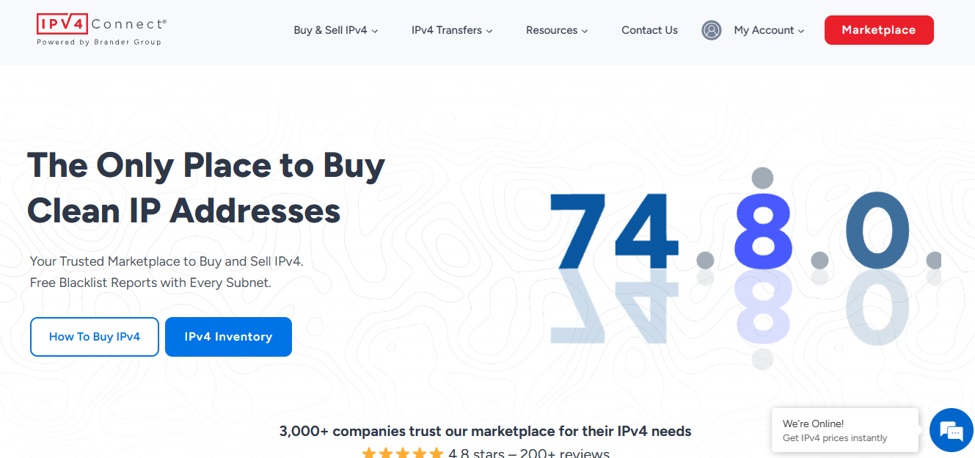
Overview: IPv4 Connect is a fixed-price IPv4 marketplace covering ARIN, RIPE and APNIC blocks from /24 up to /12, with buy-now pricing instead of auctions.
How you buy: Register free, browse inventory, reserve a subnet without payment, then pay by secure wire or escrow and start the transfer. Transfers are fully managed and typically complete in two to three weeks, with pre-approval assistance at the registry.
Block checks: Every subnet comes with a free blacklist report checking 100+ global blacklists, and the team removes old BGP announcements, route records and DNS entries before transfer.
Best for: IT teams that want a clean, ready-to-route block at a fixed price without bidding.
2. IPv4.Global
Overview: IPv4.Global runs an IPv4 marketplace alongside privately arranged transactions.
How you buy: Buy from listed inventory or arrange a private deal. Its published FAQ lists a buyer fee of $1 per address, with a $500 minimum.
Block checks: Reputation and routing evidence vary by listing, so request reports for the specific block.
Best for: Buyers who want both marketplace listings and private deal options from one provider.
3. IPXO
Overview: IPXO is a marketplace focused on leasing IPv4 addresses rather than transferring registration.
How you buy: Lease addresses under a platform subscription, which is priced separately from IPv4 leasing charges, so check both when comparing costs.
Block checks: Review the reputation evidence for the specific range before deployment.
Best for: Teams that need temporary or flexible capacity without taking on registration.
4. Prefixx
Overview: Prefixx is an IPv4 brokerage that arranges transfers between buyers and sellers.
How you buy: Buyers pay no brokerage fee, although registry, escrow or payment-service costs may still apply.
Block checks: Ask what checks are included for the specific block and request dated results.
Best for: Buyers who want broker support and prefer no buyer-side brokerage fee.
5. DCXV
Overview: DCXV is an IPv4 broker and marketplace with a review-led buying workflow.
How you buy: Work through its buying process and request a written quote for the specific block and registry path.
Block checks: Its workflow includes a reputation and routing-history check on the specific block.
Best for: Buyers who want a reputation and routing review built into the purchase process.
How to Buy Global IPv4: Step by Step
1. Size the block and confirm registry eligibility
Under ARIN policy, the minimum IPv4 transfer is a /24, which contains 256 addresses. ARIN recipients without existing allocations qualify for an initial /24. A larger initial block needs documentation showing that 50% of the requested addresses will be used within 24 months. APNIC asks recipients for a detailed plan for the transferred resource, and RIPE NCC applies its own policy, so check the rules at your receiving registry.
Before requesting quotes, record the block size you need, the legal entity that will hold the registration, its registry account, the intended use and timeline, and where the block will be announced.
2. Check the destination's requirements
Cloud bring-your-own-IP (BYOIP) programs have their own acceptance rules. Amazon EC2's BYOIP requires addresses with a clean history, accepts /24 as the most specific IPv4 prefix, and requires a route origin authorization (ROA) in the registry. Confirm your carriers' routing requirements too.
3. Investigate the exact block
- Holder and authority: compare the registry record with the seller and request proof that the seller can authorize the transfer.
- Registry path: confirm the source and receiving registries, since in-region and inter-registry transfers follow different procedures.
- Reputation: review dated blacklist results and run your own checks against the lists that matter for your workloads.
- Routing handover: confirm when old announcements will be withdrawn and how route records and reverse-DNS delegations will be cleaned up.
4. Build a complete budget
Record each cost separately: the purchase price (for a /24 quoted per address, multiply by 256), any buyer or broker fee, escrow or settlement charges, registry transfer fees, annual registry fees and internal staff time. ARIN's 2026 schedule lists its 3X-Small registration category, which covers IPv4 holdings of /24 or smaller, at $275 a year. Use the schedule for your own registry and holdings.
5. Close the transfer with clear payment terms
Agree in writing what happens if the registry rejects the transfer or the block differs from what was disclosed, including whether you get a replacement or a refund. Tie payment release to confirmation that the registry record shows your organization, and assign someone to answer registry questions quickly.
6. Validate the block before production
After the transfer, create or update routing authorizations, set up reverse DNS, request geolocation corrections where needed, and confirm provisioning through your cloud provider's BYOIP process or your carrier's acceptance of the announcement. Then test the services that will run on the new addresses. Traffic-level testing helps here; tools for Kubernetes traffic analysis can confirm that requests from the new range behave as expected before you move production workloads.
Conclusion
Buying IPv4 is a three-part job: agreeing the deal, completing the registry transfer and getting the block ready for production. The right platform makes each step easier. IPv4 Connect stands out for fixed buy-now pricing, free blacklist reports on every subnet and fully managed transfers with routing cleanup, while IPv4.Global, IPXO, Prefixx and DCXV suit buyers who want private deals, leasing, broker support or built-in reputation reviews. Whichever you choose, confirm eligibility early, check the exact block and tie payment to a completed transfer.
FAQ
What is the smallest IPv4 block I can buy?
Under ARIN policy, the minimum transfer is a /24, or 256 addresses. Check your own registry's policy.
Should I buy or lease IPv4 addresses?
Buy when you need addresses long term and want the registration under your control. Lease for temporary capacity or short projects.
How long does an IPv4 transfer take?
It depends on the registry and how quickly questions are answered. IPv4 Connect states that its managed transfers typically take two to three weeks.
How do I know a block is clean?
Review a dated blacklist report, check the block's routing history and run your own queries against the blacklists that matter for your workloads.
Can I use purchased IPv4 in AWS?
Yes, through Amazon EC2's BYOIP program, if the block meets its requirements, including a clean history, a /24 or larger prefix and a route origin authorization.