
Top ESG Software Companies for US Sustainability Reporting in 2026

Image Source: depositphotos.com
Ask a sustainability team what slowed their last disclosure and the answer is usually mundane: inconsistent units, missing supplier records, emission factors applied three different ways across four business units, and no audit trail explaining why a number changed between drafts.
That is why sustainability teams keep hiring people who think like data engineers, and why the software category has shifted from carbon calculators toward full data platforms. Below is a look at nine ESG software companies serving US and global enterprises in 2026, what each one is built for and how to evaluate them on data quality.
Key Takeaways
- Disclosure regimes have stacked rather than replaced each other, so the same emissions figure has to be reusable across California rules, the CSRD, ISSB-aligned standards and CDP.
- The deciding factor is usually data lineage: whether a reported number can be traced backward through every transformation to the source record.
- Carbon-first platforms go deeper on Scope 3, while reporting-first platforms go deeper on disclosure controls.
- Pricing is quote-based across the category, so shortlist on reporting obligations and data maturity rather than on published figures.
Why ESG Reporting Became a Data Engineering Problem
Disclosure regimes have stacked rather than replaced each other. A US multinational may now report under California's climate rules, the CSRD in Europe, ISSB-aligned standards elsewhere, plus voluntary CDP submissions, all from overlapping underlying data.
The practical consequence is that the same emissions figure has to be reusable across formats, traceable back to source and defensible to a third-party assurer. Spreadsheets do not survive that requirement at scale.
The reporting burden has also stopped being purely a compliance exercise. As climate risk management moves closer to the center of enterprise strategy, the same datasets are being asked to support planning decisions, not just filings.
How We Compared These Platforms
Each platform below was assessed on four things: breadth of framework coverage, depth of Scope 3 and supplier data handling, integration with finance and procurement systems, and the strength of audit workflows.
Vendor positioning was taken from each company's own current documentation. Ratings-agency products and pure EHS suites were excluded, since they solve adjacent problems. Pricing was left out because enterprise ESG platforms are quote-based and publish no list rates.
Nine ESG Software Companies to Know in 2026
1. Workiva
Workiva runs financial, regulatory and sustainability reporting on one connected platform, with XBRL and iXBRL tagging and detailed audit trails. It is the default choice when the sustainability report has to sit alongside the annual report and survive the same controls.
Best suited to large listed companies where finance owns the disclosure process.
2. Watershed
Watershed focuses on audit-grade Scope 1 to 3 measurement plus disclosure generation, with a dedicated California report builder for SB 253 and SB 261. Its AI reporting tools draft climate risk disclosures aligned to the four TCFD pillars, with every statement cited back to source data.
Best suited to US enterprises with a near-term California filing obligation.
3. Sweep
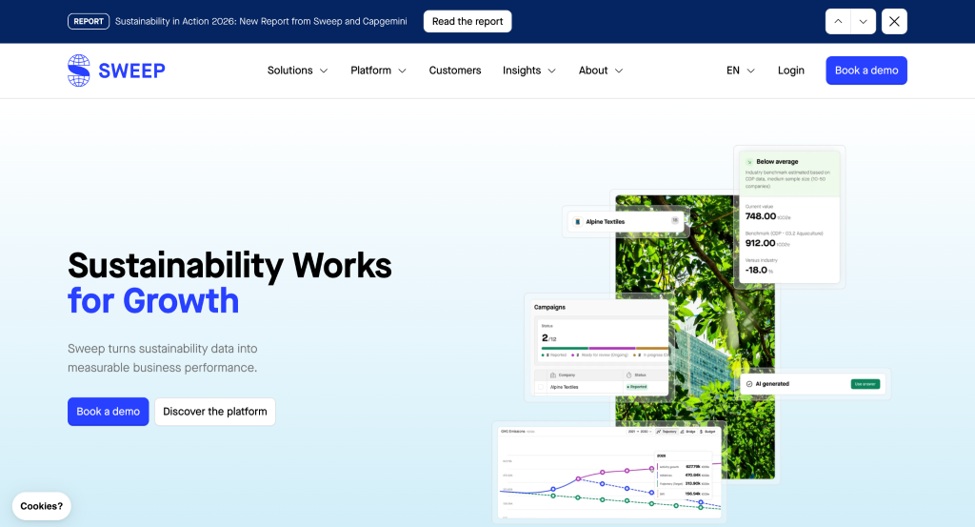
Sweep, the sustainability intelligence platform, covers Scope 1, 2 and 3 emissions, supplier engagement through customizable surveys and disclosure alignment with CSRD, SFDR, ISSB, GRI and TCFD from a single dataset. Named a Leader in both the 2026 IDC MarketScape for carbon management and the 2026 Verdantix Green Quadrant for enterprise carbon management, it publishes its own comparison of the best ESG software across the category, and counts L'Oréal, SNCF, Swisscom and Lacoste among its customers.
Best suited to enterprises and financial institutions managing complex, multi-entity reporting structures.
4. Persefoni
Persefoni treats carbon accounting with financial-reporting rigor, covering Scope 1, 2 and 3 calculations aligned to the GHG Protocol plus financed emissions for banks, insurers and asset managers. PersefoniAI adds anomaly detection across large data sets and a chat-based copilot for technical carbon accounting questions.
Best suited to financial institutions and companies preparing for third-party assurance.
5. Greenly
Greenly centralizes emissions measurement and reduction tracking, integrating physical and monetary flows to produce audit-ready data. It monitors greenhouse gas emissions on an ongoing basis and offers configurable dashboards for teams working through a decarbonization plan.
Best suited to companies that want measurement and reduction tracking in one accessible interface.
6. IBM Envizi ESG Suite
Envizi consolidates ESG and energy data inside the wider IBM ecosystem, with strong handling of facility, utility and asset-level inputs. It suits organizations with heavy operational data volumes and existing IBM infrastructure.
Best suited to asset-intensive enterprises in manufacturing, utilities and real estate.
7. Salesforce Net Zero Cloud
Net Zero Cloud brings carbon accounting into the Salesforce environment, so emissions data sits next to CRM and operational records. The appeal is administrative rather than analytical.
Best suited to organizations already standardized on Salesforce.
8. Novisto
Novisto centers on ESG data management and disclosure across multiple frameworks, with a strong metric library and workflow controls for gathering non-carbon indicators. It handles the social and governance side more thoroughly than carbon-first tools.
Best suited to teams whose reporting burden extends well beyond emissions.
9. Normative
Normative positions itself as a system of record for carbon data, with particular attention to Scope 3 visibility and support for smaller suppliers who lack their own tooling. Supplier data collection is the core differentiator.
Best suited to companies whose emissions profile is dominated by the value chain.
What to Check Before You Commit
Ask for a lineage demo, not a dashboard demo. You want one reported figure traced backward through every transformation to the source record, change log intact, whether that record came from an internal system, a supplier survey or external ESG data such as filings and public disclosures.
Then test the boring parts. How does the platform handle a restated prior year, a mid-year acquisition or a supplier who submits data in the wrong units? Those cases decide whether reporting stays manageable in year three. A platform that still relies on someone assembling figures by hand each cycle runs into the same portfolio visibility problems project teams know well: the full picture is out of date before anyone finishes building it.
Bring the commercial side of the business into the evaluation too. An ESG platform only earns its keep as part of connected digital systems rather than as another isolated tool, and where corporate responsibility is tied to growth targets rather than compliance alone, procurement and finance stakeholders tend to have sharper questions about data quality than the sustainability team does.
The Bottom Line
There is no single correct platform, only a correct match between your reporting obligations, your data maturity and who owns the process internally. Finance-led programs gravitate toward connected reporting tools, carbon-heavy programs toward measurement platforms and multi-entity global programs toward flexible data models.
Start by mapping which frameworks you must file under in the next 24 months. That list narrows a shortlist faster than any feature comparison.
Frequently Asked Questions
What is ESG software? ESG software collects, validates and reports environmental, social and governance data, then formats it for disclosure frameworks such as CSRD, ISSB, CDP and California's climate rules.
Which platforms support SB 253 and SB 261 reporting? Watershed, Persefoni, Sweep and Workiva all offer California-specific disclosure support, though their emphases differ between emissions measurement and report assembly.
How much does ESG software cost? Enterprise ESG platforms are quote-based and do not publish list pricing, so cost depends on entity count, data volume and the number of frameworks in scope.
Do I need separate carbon accounting and ESG reporting tools? Not usually. Most platforms now cover both, but carbon-first tools go deeper on Scope 3 while reporting-first tools go deeper on disclosure controls.
What data should I prepare before implementation? Utility and fuel records, procurement spend by category, travel and logistics data and a current organizational hierarchy showing every entity in scope.