Systems | Development | Analytics | API | Testing

Tricentis Webinar Series: What customers are saying about Agentic Performance Testing

As Tricentis customers continue to adopt Agentic Performance Testing, Product Marketing Manager Jason Secola sat down with APT's product manager, Twan Koot, to discuss how customers are making use of its agentic capabilities. Here, he shares customer feedback. Key highlights.
Introducing Tricentis Labs

AI is reshaping how software gets built and tested faster than most QA teams can keep pace, yet teams rarely get to influence what a vendor ships before the decision is made. That's why we created Tricentis Labs. Tricentis Labs is where agentic-AI ideas are built in public, giving quality engineering teams early access to experiments and a say in which ones become real products. In this announcement, Ryan Yackel and David Colwell walk through how Labs works and the first three experiments open to customers and partners today.

Tricentis NeoLoad Agentic Performance Testing: AI Performance Analysis in Minutes

When a performance test run goes wrong, the real work begins, which means hours of manual analysis, digging through metrics, and trying to prioritize what to fix first. Agentic Performance Testing (APT) in NeoLoad changes that. In this demo, see how APT's specialized AI agents automatically analyze a failed test complete with a full, stakeholder-ready report, surfacing an executive summary, SLA compliance breakdown, trend analysis. critical findings, a prioritized action plan, and more, all without leaving NeoLoad.

Start your AI agent testing with deterministic tooling

By now everyone is aware of the limitations inherent in generative AI and the AI agents that use it to complete their tasks, and the challenges involved in getting them enterprise quality. If you are planning to incorporate AI agents into your enterprise IT architecture, how are you planning to validate their quality and accuracy?

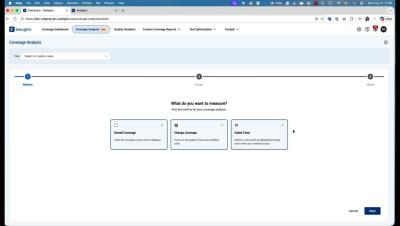
Tricentis SeaLights: Coverage analysis

Coverage analysis brings your sprint, release, and daily coverage views into one customizable dashboard in SeaLights. It only takes a few steps to build a view: pick what you want to see, set your time range and scope, and get a live breakdown by service. Key highlights: One unified view: consolidate overall coverage, change coverage, and failed test tracking into a single customizable dashboard, built exactly for your team's workflow.

Modernizing at the speed of AI: How state and local governments can keep quality in check

For the first time ever, artificial intelligence has topped NASCIO’s annual ranking of state CIO priorities, ending cybersecurity’s 12-year reign at number one. It’s easy to see why: public agencies – like their private sector counterparts – see real potential in AI to modernize operations, accelerate service delivery, and help lean teams do more with fewer resources.

Closing the gap to AI speed with a holistic test management approach

Every AI headline this year is about speed: code shipping faster, test scripts generating in seconds, releases compressing from weeks to days. What gets less attention is what happens to quality when everything around it accelerates and the way you manage testing doesn’t.

RPA or MBT? Choosing the right automated testing approach for government

Software runs mission delivery in the public sector. As agencies modernize and systems grow more connected, the cost of a failed release climbs. The result can be service disruptions, compliance gaps, and loss of public trust. Automated testing is central to managing that risk, but it raises a practical question: which approach is right? Two options come up often: robotic process automation (RPA) and model-based testing (MBT). Both support automation, but they were built for very different purposes.

Why browser-based automation can't test your ERP apps

Picture a large-scale grocery and retail chain launching its first online storefront. The setup is complicated: a single online order must travel through an SAP eCommerce platform, multiple payment and loyalty systems, before disappearing into back-end SAP supply chain and ERP apps. The complexity of merging the online and offline business is like a “digital tsunami.” For many SAP enterprises, this sounds familiar.

Where agentic AI is most valuable in performance testing

Quick summary: Performance teams can generate tests in minutes, but the analysis still takes hours. Agentic Performance Testing in NeoLoad uses domain-specialized AI agents to deliver a finished analysis from a single request, so engineers can start with the conclusions, rather than the raw data. Performance testing answers a critical question in the quality engineering lifecycle: will this hold up when real people use it, under real conditions, at real volume?