Systems | Development | Analytics | API | Testing

GitHub Investigates Internal Repository Breach Following TeamPCP Supply Chain Incident

The tech world woke up to a major shock when a notorious hacking group, TeamPCP, claimed it had broken into GitHu b’s internal systems. The group is currently selling access to roughly 4,000 of GitHu b's private code repositories on cybercrime forums, demanding a massive $50,000 ransom. If GitHub, the platform holding the code for 100 million developers worldwide, can get hacked through a single employee's workstation, what does that mean for your business?

Proven QA Practices for Healthcare Platforms: Built for Real-World Complexity and Scale

Healthcare IT systems operate in environments where even a minor failure can create clinical risks and regulatory consequences. Modern healthcare ecosystems depend on microservices, legacy databases, and multiple third-party integrations, creating vulnerabilities that traditional testing approaches often fail to detect. Engineering teams are managing sensitive information at high-velocity, ensuring that a failed connection or a missed rule never gets in the way of patient treatment.

The $2 Million Vercel Ransom: Lessons in AI Supply Chain Security

The recent security breach at Vercel, where a$2 million ransom was demanded after the Context AI OAuth breach, is a wake-up call. Vercel continues to be a pillar of the modern web, serving millions of frontend applications to enterprises around the world. A compromise on such a scale has a ripple effect throughout the enterprise ecosystem.The incident points to a particular weak point: a combination of third-party AI integrations and internal system security.

RAG Pipeline Testing: How to Validate Retrieval, Context Use & Answer Accuracy

Large Language Models (LLMs) are impressive, but they are not without significant flaws. Their biggest hurdles are "knowledge cut-offs" where they cannot access information created after their training, and a tendency to "hallucinate" or confidently state false information. These models often struggle with the specific or real-time data that modern businesses rely on daily.

LLM Output Evaluation & Hallucination Detection

As enterprises transition from experimenting with Generative AI (GenAI) to deploying Large Language Models (LLMs) in production, a critical challenge has emerged: reliability. While LLMs demonstrate remarkable proficiency in automating workflows from drafting executive communications to summarizing complex legal corpora, their susceptibility to "hallucinations" remains a significant operational risk. The scale of this challenge is non-trivial.

What Breaking AI Applications Taught Us About Building Reliable Ones

The global industry is currently in a feverish rush to "AI-enhance" every facet of the digital landscape. However, a critical distinction has emerged: while building an AI-integrated application is relatively simple, engineering one that maintains operational integrity in a production environment represents a watershed moment for modern engineering teams. BugRaptors spent the last year inside the intricate internal logic and non-deterministic layers of AI application testin g.

Automated Mobile Testing: Redefining Quality Assurance with AI Integration

The contemporary mobile ecosystem is incredibly complicated. Applications today are not standalone anymore; they are dynamic, heavy in features, and constantly communicating with cloud solutions, wearables, and IoT devices. Although the use of traditional test automation has contributed to enabling engineering teams to remain in step with agile delivery, the sheer number of fragmented devices and continually changing user interfaces has revealed the limitations associated with it.

Stryker Cyberattack: The Enterprise Security Gaps That Just Exposed a Global Healthcare Giant?

A $25 billion Fortune 500 medical device company, Stryker, was targeted by an Iran-linked hacker group that claimed to have wiped over 200,000 servers, mobile devices, and other systems, forcing the company to shut down offices in 79 countries. The medical technology industry has been hit hard by this huge problem. It's a stark warning that even the largest names in the business world can be hit by clever wiper malware.

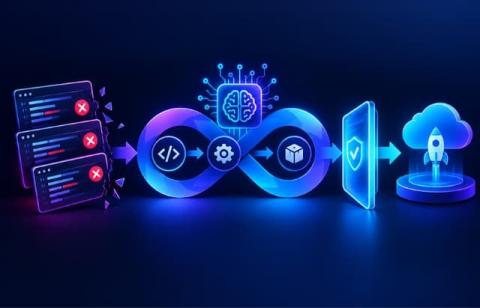
Beyond Left and Right: Why "Shift Everywhere" is the Future of DevOps

Modern software architectures have rendered traditional QA obsolete. In an era of distributed microservices and serverless functions, bugs are no longer just code errors; they are systemic interaction failures. While Agile successfully accelerated delivery, it left a critical gap in quality assurance. The industry's initial response, splitting focus between "Shift Left" and "Shift Right", created a fragmented safety net.