Systems | Development | Analytics | API | Testing

Building a Digital Banking Platform From Scratch: Architecture Decisions That Scale

Building a digital banking platform from scratch in 2026 is becoming less about launching a banking app and more about designing the right architecture from day one. The industry is moving through a major infrastructure shift. According to McKinsey Financial Services Insights, global fintech revenues crossed nearly 650 billion dollars in 2025, growing at roughly 21 percent year over year.

The Neobanking Tech Stack in 2026: A Complete Architecture Deep Dive

Here’s the uncomfortable truth. You don’t just choose a neobank technology stack, you commit to it. And that commitment compounds over time. In 2026, most fintech teams are no longer debating cloud native or API first, that part is settled. The real question is alignment. Does your architecture actually match your business model, your licensing path, and your scale ambitions? Because once you grow, changing your stack is not a simple rewrite.

CDSS EHR Integration Best Practices: A Technical Guide for Engineering Teams

Clinical AI projects usually fail during integration, not development. They work well in controlled environments, but production workflows expose problems. CDS Hooks and FHIR payloads can be inconsistent and incomplete. Engineering teams face a challenge: embedding clinical decision support into existing EHR workflows without disrupting care. The problem is not just about APIs. Teams must manage many things, including CDS Hooks, authentication, and latency constraints.

Neobank vs. Challenger Bank vs. Digital Bank: What You're Actually Building

The global financial landscape has shifted from digital-first to digital-only at a relentless pace. As we navigate 2026, the stakes for fintech founders and engineering leaders have never been higher. According to recent data from Fortune Business Insights, the global neobanking market is currently valued at approximately $310.15 billion, with a projected surge to a staggering $7.6 trillion by 2034.

Building an AI-Powered CDSS for Hospitals: Architecture, Models, and Compliance

A clinically accurate AI model can still fail inside a hospital. Not because the prediction was wrong. Because the system could not fit the reality of clinical care. The recommendation may arrive too late. The alert may interrupt the wrong workflow. The model may lack explainability. Compliance teams may block deployment before production even begins. That is where many AI-powered CDSS initiatives break down. Hospitals already struggle with alert fatigue from traditional CDS systems.

Predictive Analytics in Clinical Decision-Making: From Alerting to Anticipating

This has been the reality of clinical decision-making for years: healthcare reacts after the signal becomes visible. Traditional clinical decision support systems helped standardize care and reduce errors, but most systems relied on static rules and issued alerts only after an event had occurred. They identify danger when it is already happening, not when it is quietly forming underneath the surface. That delay is expensive clinically, operationally, and financially.

AI and Machine Learning in Healthcare Data Analytics: Use Cases, Architecture & Implementation Guide

Healthcare is sitting on a paradox. As per healthcare analytics statistics 2026 It generates more data than any other industry, nearly 30 percent of the world’s total data, yet 97 percent of hospital data still goes unused. That gap is exactly where AI and machine learning in healthcare data analytics are changing the game. We are no longer talking about dashboards or retrospective reports.

The Complete Hospital Management Software Implementation Checklist: A Step-by-Step Playbook for Hospital Leaders

The healthcare landscape in 2026 is defined by a paradox. While the global healthcare IT market is projected to skyrocket toward a US$ 961.26 billion valuation by 2030 according to MarketsandMarkets, hospital leaders are finding that the shiny new tool syndrome is a recipe for disaster. McKinsey highlights that while agentic AI and ambient listening are transforming administrative workflows, the foundation, the Hospital Management Software (HMS), remains the most frequent point of failure.

Key Integrations Required in a Modern Hospital Management System: EHR, LIS, RIS, Pharmacy, Billing & Beyond

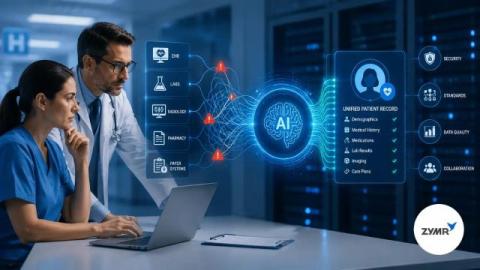
That gap is exactly where inefficiency begins. A modern hospital management system is no longer just about digitization. It is about connection. Without the connections, hospitals face significant hurdles in patient safety and data integrity. Integration is what transforms a collection of tools into a working healthcare ecosystem. When key integrations in a hospital management system are done right, everything changes. Data flows without friction. Clinicians make faster decisions.

How a Hospital Management System Improves Patient Flow, Billing & Compliance: A Practical Guide

In an era where healthcare margins are tightening and regulatory scrutiny is at an all-time high, hospitals can no longer afford to operate with siloed systems. The traditional disconnect between clinical operations and financial administration creates a black hole where data gets lost, patients wait too long, and revenue evaporates through billing errors. The solution lies in a robust, centralized hospital management system (HMS).