Systems | Development | Analytics | API | Testing

Insurance Workflow Automation: From RPA to Straight-Through Processing - The 2026 Maturity Model

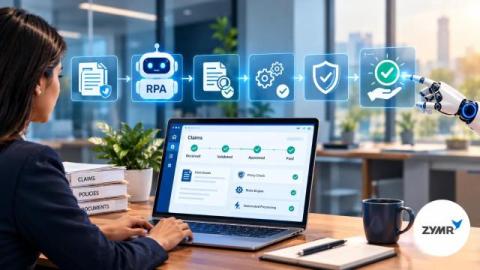
Insurance workflow automation connects data, applications, business rules, and approvals across insurance operations. It reduces manual handoffs across claims, underwriting, billing, and policy servicing the same discipline behind Zymr’s work in the adjacent fintech and BFSI space. RPA automates repetitive tasks but cannot manage complex, end-to-end decisions independently.

Claims Administration: What It Covers and How to Streamline It

In 2026, claims administration connects intake, assessment, reserves, payments, compliance, and performance reporting. It directly affects settlement speed, operating costs, financial accuracy, and customer satisfaction. Insurers need integrated data, automated workflows, and consistent decision controls.

Insurance Underwriting Automation: Architecture, AI Models, and ROI (2026)

Insurance underwriting automation integrates data ingestion, validation, risk scoring, decisioning, and policy workflows. It connects core insurance platforms with rules engines, AI models, and external data sources. Insurance underwriting automation in 2026 looks markedly different from earlier pilots.

AI in Claims Processing: What's Actually Working in 2026

‍AI claims processing applies predictive models, machine learning, computer vision, and generative AI across claims workflows. These technologies analyse documents, images, policy terms, historical records, and structured claim data. Insurers use AI for document extraction, claim triage, fraud detection, damage assessment, and adjuster assistance. Predictive models classify claims, estimate severity, and identify cases requiring specialist review.

How AI Is Rebuilding the Insurance Claims Automation Lifecycle: The 2026 Guide

AI is restructuring how insurers run the claims lifecycle end to end from first notice of loss through payment and closure. This guide breaks down where AI insurance claims automation is delivering measurable results in 2026, the reference architecture behind it, and what insurers should prioritize first. Insurance claims automation 2026 connects AI, workflow orchestration, and core systems across the claims lifecycle the specific discipline behind Zymr’s own claims processing automation practice.

AI-Powered Claims Automation in 2026: How LLMs and Intelligent Document Processing Transform Insurance Operations

AI claims automation is becoming a major focus for insurers as manual claims processing continues to create cost, speed, and customer-experience challenges. Traditional systems often route documents through multiple human reviewers, creating bottlenecks that consume time and operational resources.

Top Healthcare Interoperability Companies to Know in 2026

The healthcare interoperability vendors 2026 buyers are evaluating enable secure data exchange across providers, payers, patients, and digital health platforms. Their solutions connect fragmented systems through Fast Healthcare Interoperability Resources (FHIR) APIs, Health Level Seven (HL7) interfaces, identity matching, and terminology mapping. Vendor selection is critical because most Centers for Medicare & Medicaid Services (CMS) CMS-0057-F API requirements begin in January 2027.

Healthcare Interoperability Solutions: Types, Approaches, and How to Choose (2026)

Healthcare interoperability solutions enable secure data exchange between EHRs, payers, laboratories, devices, and patient applications. Zymr's healthcare engineering teams work across all of these categories, which is where the framework below comes from. These solutions use standards such as HL7 FHIR to structure data and support API-based integration.

How to Improve Interoperability in Healthcare: A Practical Roadmap (2026)

Healthcare interoperability enables clinical, administrative, and financial systems to exchange usable health information securely. It connects EHRs, payer platforms, laboratories, pharmacies, medical devices, and patient applications. In 2026, interoperability requires more than transferring data between disconnected systems. Healthcare organizations must standardize data models, resolve patient identities, govern access, maintain semantic consistency, and support real-time API-based workflows.