Systems | Development | Analytics | API | Testing

From Bug Counters to Risk Officers | Rupernita Sahoo

In this fireside chat, Rupernita Sahoo explore the fundamental shift taking place in software quality assurance. Executive teams no longer want traditional defect counts - they want QA leaders to quantify business risk, security posture, and compliance. However, many QA organizations, legacy tools, and success metrics are still anchored in the past. This fireside chat explores how QA leaders can navigate this transition while maintaining strong operational delivery and driving greater business impact.
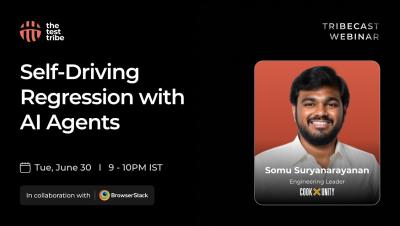
Self-Driving Regression Testing with AI Agents | Somu Suryanarayanan

This session looks at how agentic automation can take over web and mobile regression. We start with the regression tax: the slow 3-day cycle, the manual triage, and the flaky reruns nobody trusts. We then cover why scripted suites hit a wall and make the case for handing regression to agents instead. The core of the talk is how it actually works, with Appium MCP driving mobile and Playwright MCP driving web, interpreting intent rather than hard-coded steps and adapting when the UI shifts.

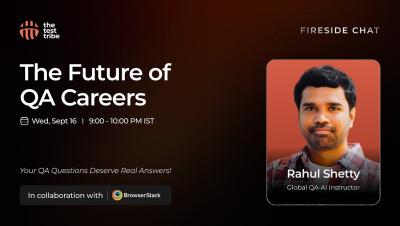
What's Next for QA Careers? | Fireside Chat with Rahul Shetty

In this fireside chat, Rahul Shetty - one of the most widely followed test automation educators - explores how AI is reshaping testing careers, which QA roles and skills are gaining relevance, and what testers should focus on learning next. He also shares how AI is being used by real testing teams, what interview panels are looking for in 2026, and how testers can stay relevant as the industry evolves. A practical conversation on the future of QA, beyond the AI hype.

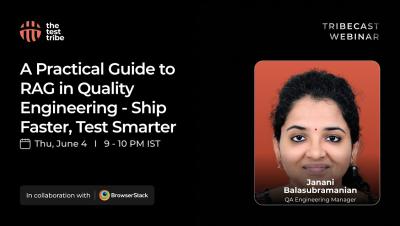
RAG in Quality Engineering: Ship Faster, Test Smarter | Janani Balasubramanian

How can Retrieval-Augmented Generation (RAG) help Quality Engineering teams ship faster and test smarter? In this TTTribeCast session, Janani Balasubramanian explores the practical applications of RAG in Quality Engineering and how teams can use organizational knowledge, testing data, and engineering context to improve the way they design, prioritize, and execute testing.

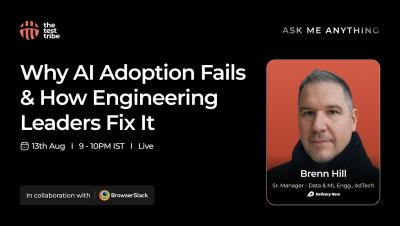
AI Adoption: What Goes Wrong & How Leaders Fix It | Brenn Hill

In this interactive AMA session, Brenn Hill, AI executive and author of The Delivery Gap, explores why many AI adoption initiatives fail to create lasting impact despite growing investment and enthusiasm. Drawing from his experience helping engineering organizations adopt AI at scale, Brenn unpacks the common pitfalls that hold teams back and shares practical strategies for engineering leaders to drive meaningful adoption. The session will cover how to align AI with business goals, measure success beyond hype, and build a culture that enables sustainable AI-driven transformation.

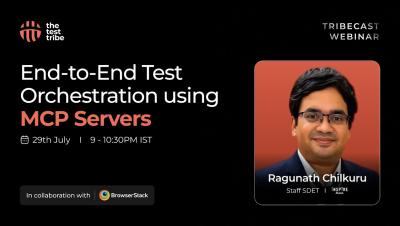
End-to-End Test Orchestration using MCP Servers | Raghunath Chilkuru

Most QA teams are still switching between requirement docs, their local codebase, and CI/CD dashboards to get automation done. This session is about closing that gap -using AI not as a code generator you prompt occasionally, but as something closer to an actual QA teammate working inside your IDE. ​Key Takeways:​A working understanding of MCP architecture - how to configure and run local or cloud-based MCP servers to connect your IDE with enterprise tools.

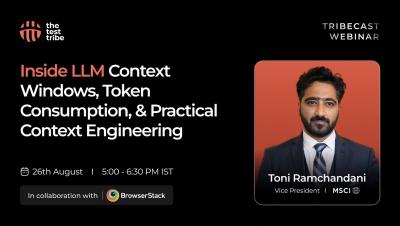
What is LLM Context Windows & Context Engineering? Explained by Toni Ramchandani

This session takes a practical look inside LLM context windows and token consumption, exploring what happens when context enters a model - from tokenization, embeddings, attention, QKV, prefill, and decode to KV caching. It also examines how context windows are allocated and why simply increasing context length doesn’t always lead to better model performance.

Accelerating Agile with BDD. Practical Guide for Testers and Teams | Ashwini Lalit

BDD (Behavior-Driven Development) is an agile approach comprising three key practices: discovery, formulation, and automation. This methodology aims to improve software development by reducing ambiguities, enhancing collaboration, and creating living documentation. In BDD, acceptance tests stay stable because business rules change less than the UI. They can be written before the UI and describe business actions that guide development, serving as the application’s business vocabulary.

Making AI Work in Real Teams. Operationalizing AI Explained | Melissa Tondi

Let's talk about the real-world journey of operationalizing AI—what it looks like behind the scenes when you’re scaling solutions, building support systems, and doing it all with a lean team. There are plenty of brilliant AI experts—folks doing deep work, research, experimentation, and implementation. This session complements and focuses on how to operationalize, centralize and scale your team, organization and company!

How to Use GenAI to Build Load Test Scripts in Apache JMeter | Sandeep Garg

This demonstration shall suggest those baby steps that should encourage most of us (the testers) to inculcate the habit of exploring* GenAI and LLMs. The exploration shall help understand why, what, where, when and how we should use these rapidly moving technologies to bring efficiency and better thinking in our day-to-day testing work.