Systems | Development | Analytics | API | Testing

Stream Governance: Making Compliance a Property of Data in Motion

As organizations have transitioned from batch processing to real-time streaming architectures, a critical governance gap has emerged. Legacy data governance tools designed for databases, warehouses, and file systems assume that information is stationary and focus on protecting, classifying, and auditing data at rest.

Building Secure, Resilient, and Compliant Fraud Detection With Confluent Cloud

Banking customers expect financial transactions to be completed quickly. Fraud analysis must execute in milliseconds, so traditional batch processing systems are inherently too slow. To safeguard transactions, institutions must shift to proactive, in-flight prevention. Confluent enables this shift by using Apache Kafka and Apache Flink to continuously correlate transactional and behavioral signals, blocking malicious activity before a transaction settles.

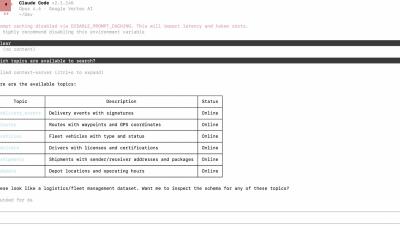
Demo: Real-Time Context Engine for Fleet Management

Use Real-Time Context Engine and Claude, or any MCP-compatible client, to explore operational data using natural language in real time. That includes everything from simple lookups to multi-step investigative questions like: Confluent’s Real-Time Context Engine gives AI agents live access to operational context as events happen across the business. Instead of relying on stale snapshots, agents can query and reason over continuously updated tables in real time.

How to Eliminate Training-Serving Skew With a Unified Real-Time Streaming ML Pipeline (2026 Guide)

The problem. Predictive ML pipelines that maintain separate batch and streaming code paths for the same features carry training-serving skew, the gap between the features a model was trained on and the features it sees at inference time. Skew silently degrades model accuracy and doubles infrastructure cost. The recommendation. Adopt a unified streaming (kappa) architecture.

Real-Time Hyper-Personalization in 2026: Architecture Guide

Hyper-personalization in 2026 is the ability to act on a user's current intent within the current session, using signals from across the journey. Batch customer data platforms (CDPs) can't do this. They can't capture intent as it forms, can't hold session state, and can't activate inside the intent window.

Meeting Data (and Analytics) Engineers Where They Are: Introducing the dbt Adapter for Confluent Cloud

dbt is the most commonly used tool by data engineers to define SQL transformations (as models), write tests, generate documentation, and deploy through CI/CD and now it’s available with Confluent Cloud too! The magic of dbt is that it brings the engineering rigor to modern data work and data engineering, regardless of the underlying compute source - Snowflake, BigQuery, Databricks, Redshift or Confluent. You can find out more about the launch in our Q2 Confluent Cloud Launch post and the keynote.

Build vs Buy Streaming for Real-Time RAG: 2026 Guide

Moving a retrieval-augmented generation (RAG) prototype from a Python notebook into production isn't an API orchestration challenge. It's a distributed systems problem. For engineering managers and data platform leads, the build-versus-buy decision on streaming infrastructure will dictate your artificial intelligence (AI) feature velocity for the next three to five years. This guide assumes you've already prototyped a RAG pipeline.

Build Compliant AI Agents With Stateful Stream Processing

The EU AI Act's general provisions are already in force, and high-risk AI system obligations apply from August 2026. The National Institute of Standards and Technology (NIST) AI Risk Management Framework and its Generative AI Profile set the baseline for what auditors expect, framing governance around four functions: identify, measure, manage, and monitor. Deploying artificial intelligence (AI) agents in regulated environments isn't a sandbox experiment anymore. It's a strict governance challenge.

Architectural Decision Guide: When to Use Apache Kafka (And When You Shouldn't)

Your team just shipped a microservices refactor. Services are smaller, deployments are faster, and boundaries are clearer. Then, during a design review, someone inevitably suggests: “We should use Kafka.”That suggestion might be the exact architectural breakthrough you need—or it could quietly introduce months of unnecessary operational complexity.This article serves as a practical decision framework.

Apache Kafka 4.3.0 Release Announcement

We are proud to announce the release of Apache Kafka 4.3. This release contains many new features and improvements. This blog post will highlight some of the more prominent ones. For a full list of changes, be sure to check the release notes. With 25 KIPs and over 600 commits since 4.2.0, this release introduces many new features, improvements and bug fixes to all the components. See the Upgrading to 4.3 section in the documentation for the list of notable changes and detailed upgrade steps.