Systems | Development | Analytics | API | Testing

Top Healthcare Interoperability Companies to Know in 2026

The healthcare interoperability vendors 2026 buyers are evaluating enable secure data exchange across providers, payers, patients, and digital health platforms. Their solutions connect fragmented systems through Fast Healthcare Interoperability Resources (FHIR) APIs, Health Level Seven (HL7) interfaces, identity matching, and terminology mapping. Vendor selection is critical because most Centers for Medicare & Medicaid Services (CMS) CMS-0057-F API requirements begin in January 2027.

Healthcare Interoperability Solutions: Types, Approaches, and How to Choose (2026)

Healthcare interoperability solutions enable secure data exchange between EHRs, payers, laboratories, devices, and patient applications. Zymr's healthcare engineering teams work across all of these categories, which is where the framework below comes from. These solutions use standards such as HL7 FHIR to structure data and support API-based integration.

How to Improve Interoperability in Healthcare: A Practical Roadmap (2026)

Healthcare interoperability enables clinical, administrative, and financial systems to exchange usable health information securely. It connects EHRs, payer platforms, laboratories, pharmacies, medical devices, and patient applications. In 2026, interoperability requires more than transferring data between disconnected systems. Healthcare organizations must standardize data models, resolve patient identities, govern access, maintain semantic consistency, and support real-time API-based workflows.

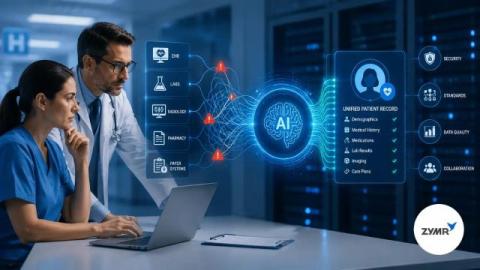
Top Challenges of Interoperability in Healthcare and How AI Is Helping Solve Them

Healthcare interoperability enables clinical and administrative systems to exchange usable patient information. However, connectivity alone does not ensure accurate interpretation or workflow compatibility. Many of the challenges with interoperability in healthcare have less to do with moving data and more to do with whether the receiving system understands what that data means. FHIR standardizes healthcare data exchange through structured resources and implementation frameworks.

FHIR vs HL7: The Real Question in 2026

Healthcare is becoming more connected than ever, but most hospitals still rely on decades old systems to exchange clinical data. At the same time, AI, cloud platforms, patient apps, and new interoperability regulations are driving organizations toward modern API based architectures. According to Deloitte, 90% of healthcare executives expect digital technology adoption to accelerate in 2025, while McKinsey found that 85% of healthcare leaders are already exploring or implementing generative AI.