Systems | Development | Analytics | API | Testing

Modern Software Development For Today's Systems & Applications




The $11 Billion Question: What the acquisition of Confluent by IBM means
What’s remarkable is how long Confluent competed at the highest level. Creating a category and type of application is hard; transitioning to cloud and surviving against hyper scalers is even harder. That alone is a huge achievement. Some see this as a pressured exit. But another way to look at it is as a strategic purchase by IBM to strengthen its position in enterprise data movement and integration.

JSON schemas to control your Lenses & infrastructure provisioning
When we talk about JSON schema in the world of Kafka and streaming, you may assume the schema for the events/messages. But how many times have you fumbled in the configuration about trying to get an application deployed? Schemas that describe how to configure and deploy Applications or applications-as-code, are also important, allowing us to automate application landscapes. Especially as we will soon be a wash with catalogs for AI Agents, MCP servers etc.
Fat Fingers? Not With Our K2K Config Schema Protector!
Picture this: It's 3 AM. You’re on-duty in case there is an outage. A team in the other part of the world merged PR and released a new version of K2K Replicator and it crashed. Consumer group lag is spiking to the universe. You’re paged & woken up, went to your laptop, the team already reverted PR, things are stabilising, but what really happened, you have to investigate now as postmortem has to be done.
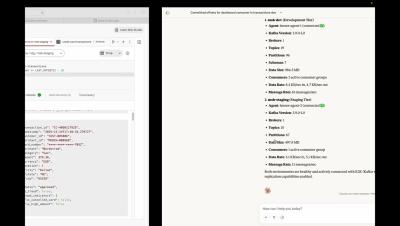


How Lenses MCP Brings AI to Kafka | Talk to Your Data with Claude & MCP
In this video, Tun Shwe (@DataSurfer), Head of AI at Lenses.io, takes you on a journey through the Lenses MCP Server - the bridge between AI models and Apache Kafka. Discover how engineers, analysts, and compliance teams can now interact with Kafka using natural language.

Topic & data multi-Kafka governance with your AI-assistant
If you’ve been running Kafka for a while, with any luck you have quite a few engineering teams onboarded, potentially with hundreds or even thousands of applications. Hopefully the Lenses.io Developer Experience platform helped in this adoption. But finding the right balance between governance and openness can be tricky.