Orchestrating distributed AI workloads Distributed (multi-node) training has become a requirement rather than an optimization for many modern AI workloads. As model sizes grow, datasets expand, and training timelines tighten, teams increasingly rely on multiple machines, often with multiple GPUs each, to complete training efficiently.
As organizations expand their AI initiatives, they increasingly need to provide users, be they data scientists, AI/ML engineers, researchers, or application developers, with secure access to interactive development environments such as JupyterLab, VS Code, or other internal tools.
GPU underutilization costs enterprises millions annually, with expensive accelerators frequently running single workloads at a fraction of their capacity. According to ClearML’s 2025-2026 State of AI Infrastructure at Scale report, almost half (49.2%) of IT leaders at F1000 companies identified maximizing GPU efficiency across existing hardware, including shared compute and fractional GPUs, as their top priority for expanding AI infrastructure over the next 12-18 months.
By Erez Schnaider, Technical Product Marketing Manager, ClearML Slurm has powered HPC environments for years. It is battle tested, widely adopted, and deeply embedded in research and engineering workflows. Over 60% of the TOP500 supercomputers use it to manage their large infrastructure, orchestrate workloads and schedule jobs, as it is powerful and versatile with over 20 years of engineering behind it.
ClearML Enterprise v3.27 delivers on the three capabilities most requested by practitioners : clear visibility into compute consumption inside projects, simpler and safer access control for remote sessions and deployed endpoints, and quality-of-life upgrades across the UI. The result is better cost control, stronger governance, and faster day-to-day execution.
By Erez Schnaider, Technical Product Marketing Manager, ClearML The GPU-as-a-Service market is experiencing hyper growth. Yet across telecommunications companies, cloud service providers (CSPs), and enterprise organizations, GPU infrastructure has been viewed as a necessary cost center rather than a strategic asset. This perspective is changing as energy optimization technologies and multi-tenant capabilities transform GPU infrastructure into monetization engines and competitive differentiators.
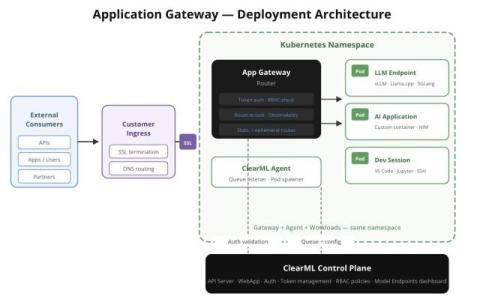
By Erez Schnaider, Technical Product Marketing Manager, ClearML The number of AI applications are rapidly increasing, and it can be difficult to keep up. Every month brings a new protocol, LLM, or tool. In this environment, the true strength of a platform is measured not only by its core features but also by its extensibility and adaptability to change. Many platforms address this challenge by hosting OSS tools or exposing API connections.
The era of simple, scripted AI is swiftly fading. We’re now witnessing the dawn of AI Agents: sophisticated, self-governing digital entities that possess the capacity to comprehend their surroundings, navigate intricate problems, and execute purposeful actions. Multi-agent systems take this even further, multiplying these capabilities by enabling teams of AI agents to collaborate, delegate tasks, and solve challenges collectively in ways a single agent cannot achieve alone.
Every week brings a new breakthrough in AI, and a new strain on infrastructure. One day, you’re fine-tuning a small model on a local machine. The next, you’re trying to schedule workloads that consume dozens of GPUs across multiple locations. And that doesn’t include the pace of new hardware, which increases what you can do.