








Santa Clara, CA, USA
2005
  |  By Akindu Himan
The rapid proliferation of Artificial Intelligence (AI) agents and Large Language Models (LLMs) is transforming how businesses operate. From automating customer service to generating complex reports, AI agents are becoming indispensable. However, this explosion of AI-driven interactions brings with it significant challenges in management, security, and governance.
  |  By Dinith Herath
The WSO2 API Platform offers an MCP Gateway that sits between MCP clients and the MCP servers they use, applying security, access control, rate limits, observation, and policy enforcement across all tool calls. Instead of requiring teams to write these controls directly within their MCP servers, the platform extends its existing API governance layer to cover MCP traffic.
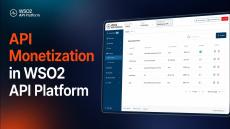
As the technology stacks utilised by modern businesses grow increasingly complex, so does the number of integrated applications that are required to work together. The key enablers of this collaboration are Application Programming Interfaces (APIs), which act as the "glue" between applications, machines and databases, and let the different elements of an organisation's system work together as one cohesive whole.
  |  By sameera gunarathne
The European healthcare landscape is undergoing its most significant digital transformation in decades. We are moving away from a fragmented era where health data was locked within the walls of individual hospitals and national borders. In its place, the European Health Data Space (EHDS) is emerging, a unified digital ecosystem designed to give patients control over their data and unleash its potential for research and innovation.
  |  By WSO2
Platform portfolio enables enterprises to deploy AI capabilities that are secure, observable, manageable, and sovereign.
  |  By WSO2
Vitality, the UK's third-largest health and life insurance provider operating under a shared value model, implemented major advancements in its digital transformation journey by partnering with WSO2, a leader in open-source API management and integration technologies.
  |  By Dr. Rania Khalaf, Chief AI Officer
AI is advancing at breakneck speed-from basic rule-based systems to autonomous agents. Over 240,000 AI papers are published annually, with 1.8M+ projects on GitHub and 80+ large language models released in 2024 alone. Forecast AI spend is expected to top $632B by 2028. Amid the hype, the focus must be on delivering real value and preparing for what's next.
  |  By Sharya Unamboowe
Choosing a software deployment model for modern organizations is complex. Regulatory compliance, data privacy, security, and operational overheads are just some of the factors that need to be considered. These factors can also change over time for reasons ranging from the introduction of new government regulations, to changing business models, to business expansion to new geographies, and more.
There is a seismic shift in software development with the advent of AI combined with the "shift left" movement. This leaves developers with competing priorities. Where AI is concerned, they are under pressure to get software to market faster. But as security requirements shift left, they are taking on more tasks and responsibilities than simply coding.
  |  By Dinusha Senanayaka
In the enterprise technology landscape, consistency is often the hardest metric to maintain. At WSO2, we view our customer feedback as a critical North Star, guiding our commitment to providing transparent, high-performance API, integration, and identity solutions. We are pleased to announce our latest customer survey results for the second half of 2025 (H2). These figures not only reflect a successful six-month period but also cap off a year of remarkable stability in our global customer relationships.
  |  By WSO2
As AI agents begin interacting with APIs, traditional API governance models need to evolve. In this DeveloperWeek session, Derric Gilling (WSO2) explains how organizations can manage and secure agent-driven API consumption using the Model Context Protocol (MCP). Unlike human applications, AI agents can generate large volumes of API calls from a single prompt. Without proper controls, this can lead to unexpected costs, security risks, and limited visibility into how APIs are being used.
  |  By WSO2
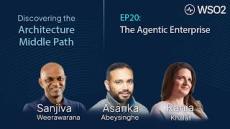
In this episode, *Dr. Sanjiva Weerawarana* and *Asanka Abeysinghe* are joined by WSO2 Chief AI Officer *Rania Khalaf* to discuss what the agentic enterprise really means. The conversation looks beyond AI pilots and explores the architectural foundations needed to make agents practical at enterprise scale. Topics include agents as first-class actors, the platform capabilities required to support them, and why identity, policy, observability, and audit matter in an agentic world. The episode closes with a practical view of what architects should start doing now.
  |  By WSO2
Prior authorization is one of the biggest drivers of clinician burnout and care delays, costing the U.S. healthcare system billions in administrative waste every year. Traditional automation hasn't been able to handle the complexity of real-world clinical documentation. Until now. In this session, we go beyond the AI hype to show real outcomes of AI in healthcare, demonstrating how Agentic Conversational AI, integrated directly into EHR workflows, is transforming the prior authorization process.
  |  By WSO2
Intelligence isn't enough. To make smart decisions, AI agents need context. Shafrine (WSO2) breaks down why integration is the secret sauce to moving AI from a pilot project to a high-performing "agentic" workforce. Learn how connecting your siloed systems provides the "informed decision-making" power agents need to actually get work done.
  |  By WSO2
Learn how to create, deploy, and manage a self-hosted gateway using the *WSO2 API Platform.* A self-hosted gateway allows you to maintain control over where and how you deploy APIs while utilizing a unified control plane in WSO2 API Platform.
  |  By WSO2
Struggling to scale your AI? You aren’t alone. Shafrine from WSO2 identifies the bottleneck holding companies back: Data Silos. Without integration, your AI agents lack the "context" needed to be useful in a production environment. Learn how to bridge the gap between a "cool pilot" and a "scalable enterprise agent" by fixing your fragmented workflows.
  |  By WSO2
Generative AI offers incredible potential, but it comes with real risks like data leakage and prompt attacks. In this video, we demonstrate how WSO2 AI Guardrails act as an intelligent filter to secure your AI integrations and ensure compliance. We walk through the configuration of four critical advanced guardrails to inspect both incoming requests and outgoing responses, helping you move from risky experiments to safe, reliable production services.
  |  By WSO2
In this episode of, *Steve Jordan* and *Shafreen Anfar* from WSO2 explore how integration is paving the way for the agentic enterprise, where humans and AI agents collaborate to drive business success. They discuss how seamless connectivity across systems provides agents with the real-time context and ability to take action that is necessary to scale AI from simple pilots to full-scale production. The conversation also highlights the importance of robust security, governance, and observability in managing this new digital workforce.
  |  By WSO2
Generative AI offers incredible potential, but it comes with real risks like data leakage and prompt attacks. In this video, we demonstrate how WSO2 AI Guardrails act as an intelligent filter to secure your AI integrations and ensure compliance. We walk through the configuration of four critical advanced guardrails to inspect both incoming requests and outgoing responses, helping you move from risky experiments to safe, reliable production services.
  |  By WSO2
Learn how to ensure consistent AI interactions and drastically reduce latency using the WSO2 AI Gateway. This step-by-step tutorial demonstrates how to standardize your LLM requests for quality and efficiency while cutting down on redundant API costs. We explore "Prompt Management" to enforce organizational guidelines using templates and decorators, and "Semantic Caching" to leverage vector embeddings—serving instant, cached responses for semantically similar queries to minimize expensive LLM calls.
  |  By WSO2
APIs have been in the technology canvas for nearly two decades now, with almost all the major software vendors releasing their APIs after the year 2000. For example, Salesforce and eBay released their APIs in 2000, Amazon in 2002, and Facebook in 2006. Today, APIs are a fundamental building block in digital business and integrations.
  |  By WSO2
Customer Identity and Access Management (CIAM), a subgenre of IAM, enables organizations to scale and ensure secure, seamless digital experiences for their customers, while collecting and managing customer identity data purposefully. Powerful CIAM solutions provide a variety of key features including customer registration, social logins, account verification, self-service account management, consent and preference management, single sign-on (SSO), multi-factor authentication (MFA), and adaptive authentication as well as other nice-to-have features.
  |  By WSO2
Current estimates suggest widespread adoption of open source software (OSS) in organizations worldwide. Compared to sectors such as operating systems and big data, adoption in the security and identity management sector has been low until now. While there were a number of open source projects around libraries for security and identity management-related functionalities, there were only a few projects based on an end-to-end security or identity and access management (IAM) solution.
  |  By WSO2
With the fast-growing popularity of cloud computing, an increasing number of organizations are now moving towards cloud-based solutions. Gartner predicts that1, "by 2020, 90 percent of organizations will adopt hybrid infrastructure management" where some parts of a solution would be in the cloud while other parts would be in traditional on-premises data centers.
  |  By WSO2
Identity and access management (IAM) is the efficient integration and management of identities, giving users access to the right resources at the right time. Identity is no longer a mere security project for enterprises. In the integration and API domain, as businesses continue to increase the number of internal and third-party APIs, it's more important than ever that APIs are integrated and governed securely. In the user domain, with increasing user identity spaces, company-wide policies, complex structure hierarchies and roles, regulatory pressures, and customer-facing applications, security becomes a bigger challenge each day for identity architects and administrators.

Founded in 2005, WSO2 enables thousands of enterprises, including hundreds of the world's largest corporations, top universities, and governments, to drive their digital transformation journeys—executing more than 18 trillion transactions and managing more than 500 million identities annually. Using WSO2 for API management, integration, and customer identity and access management (CIAM), these organisations are harnessing the full power of their APIs to securely deliver their digital services and applications.

Our open-source, API-first approach to software that runs on-premises and in the cloud helps developers and architects to be more productive and rapidly compose digital products to meet demand while remaining free from vendor lock-in. WSO2 has over 900 employees worldwide with offices in Australia, Brazil, Germany, India, Sri Lanka, the UAE, the UK, and the US.

Our Products:

  • Choreo - iPaaS: Reduce complexity. Build cloud-native, digital products and solutions with agility and at scale.
  • API Manager: Harness the full power of your APIs to optimize business performance.
  • Enterprise Integrator: Speed application development with the fastest integration runtime available in the market.
  • Identity Server: Effectively build API-driven CIAM solutions that delight customers.

Next-generation technologies to future-proof your business.