Systems | Development | Analytics | API | Testing

Meet Qlik Answers

Discover how Qlik Answers transforms the way teams work with data. As part of Qlik’s newly released agentic experience in Qlik Cloud, Qlik Answers brings together natural language interaction, the power of the Qlik Analytics Engine, and governed, trusted data, all supported with transparent reasoning and citations.

Qlik for Snowflake - From Ingestion to Insights

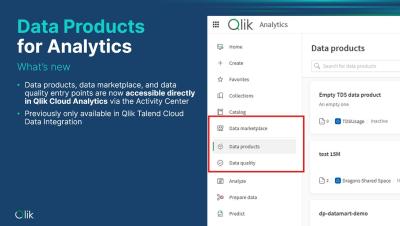
In partnership with Snowflake, Qlik helps customers modernize data estates end to end—from ingestion to insight—using Qlik Talend Cloud Data Integration and an internal data marketplace. With no‑code/SQL pipelines, thousands of secure connectors, and built‑in governance and lineage, Qlik automates trusted data movement into Snowflake and turns it into certified, reusable data products—an “app store for insight”—that accelerate time to value and power advanced analytics and AI.

Why Every AI Deployment Needs a Pre-Flight Data Checklist

You’re in the cockpit of a small plane, cruising a few thousand feet in the air. Then, out of nowhere, the airspeed dips and an alarm rings out. The nose drops, and you're in a full-out stall by the time instinct kicks in. You pull back on the yoke, trying to steady the plane, stop the descent and patch things up midair. But that’s exactly the move that seals your fate, sending you into a deeper spiral.

Qlik: Making Data Work for AI

AI is moving fast, but outcomes still depend on one thing: trusted data, in the right place, at the right time, with the right controls. In this short Qlik story video, you’ll see how we help teams accelerate AI with confidence, turning data into answers you can explain, and actions you can stand behind. From strengthening supply chain decisions, to building a campaign plan in seconds, to spotting changes as they happen, Qlik connects analytics, automation, and governed AI experiences, so AI becomes operational, not experimental.

Making Data Work for AI

AI is not a pilot anymore. In 2026, it is the operating agenda. And if you’re leading a business or an IT project right now, you’re probably getting the same two questions. First: “When do we see real outcomes?” Second: “Can we trust what we’re getting?” Those are fair questions. They’re the right questions. Because the truth is, the model is rarely the problem. The hard part is everything around it. The data. The access. The silos. The controls.

Building for Agentic AI

Our customers’ worlds are complex, and for good reason. It’s multi-cloud. It’s SaaS plus on-prem. It’s Snowflake, Databricks, AWS, Azure, Salesforce, and more. Underneath every one of those choices is the same constraint: data must be accessible, stay current, and stay controlled. The hard part is getting trusted data where it needs to be, when it needs to be there, with the controls to use it responsibly.

International Data Privacy Day: Why Data Residency and Sovereignty Will Become Even More Important in 2026

January 28th marks International Data Privacy Day, a day to raise awareness about the importance of privacy and promote best practices. Privacy has long been about maintaining control of your data, in particular where it goes, and who can see it, and what it’s used for. Two topics under this theme, data residency and data sovereignty, come up in almost every customer conversation at the moment. While closely aligned, there are key differences.

Qlik Joins Snowflake-Led Open Semantic Interchange to Bring Consistent Business Meaning to Analytics and AI

If you have ever asked three teams for the definition of the “same” metric and gotten three different answers, you have already met one of the most expensive, least talked about problems in modern data. It is not a lack of data. It is a lack of shared meaning. As analytics and AI spread across more tools, clouds, and teams, business context often fails to travel with the data. A metric defined one way in a dashboard gets redefined in a notebook.

Building the Foundation for Responsible Autonomy: Preparing for the Agentic Era of AI

Over the past two years, generative AI has transformed how we create, learn, and interact. But a more profound shift is already underway—one that changes not just how we work but who (or what) does the work itself. We are entering the era of agentic AI, where systems don’t merely answer questions—they reason, decide, and act on our behalf.