Systems | Development | Analytics | API | Testing

Why do we need DataOps Observability?

DevOps was started more than a decade ago as a movement, not a product or solution category. DevOps offered us a way of collaborating between development and operations teams, using automation and optimization practices to continually accelerate the release of code, measure everything, lower costs, and improve the quality of application delivery to meet customer needs.

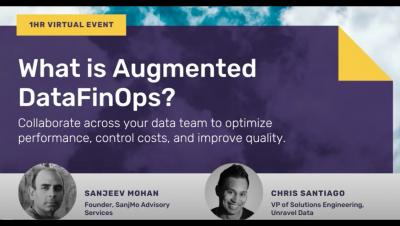
Maximize Business Results with FinOps

As organizations run more data applications and pipelines in the cloud, they look for ways to avoid the hidden costs of cloud adoption and migration. Teams seek to maximize business results through cost visibility, forecast accuracy, and financial predictability. Watch the breakout session video from Data Teams Summit and see how organizations apply agile and lean principles using the FinOps framework to boost efficiency, productivity, and innovation. Transcript available below.

Enabling Strong Engineering Practices at Maersk

As DataOps moves along the maturity curve, many organizations are deciphering how to best balance the success of running critical jobs with optimized time and cost governance. Watch the fireside chat from Data Teams Summit where Mark Sear, Head of Data Platform Optimization for Maersk, shares how his team is driving towards enabling strong engineering practices, design tenets, and culture at one of the largest shipping and logistics companies in the world.

Taming Cloud Costs for Data Analytics with FinOps

Uncontrolled cloud costs pose an enormous risk for any organization. The longer these costs go ungoverned, the greater your risk. Volatile, unforeseen expenses eat into profits. Budgets become unstable. Waste and inefficiency go unchecked. Making strategic decisions becomes difficult, if not impossible. Uncertainty reigns.

Eckerson Report: Data Observability for Modern Digital Enterprises

This Eckerson Group report gives you a good understanding of how the Unravel platform addresses multiple categories of data observability—application/pipeline performance, cluster/platform performance, data quality, and, most significant, FinOps cost governance—with automation and AI-driven recommendations.

Panel recap: What Is DataOps observability?

Data teams and their business-side colleagues now expect—and need—more from their observability solutions than ever before. Modern data stacks create new challenges for performance, reliability, data quality, and, increasingly, cost. And the challenges faced by operations engineers are going to be different from those for data analysts, which are different from those people on the business side care about. That’s where DataOps observability comes in.

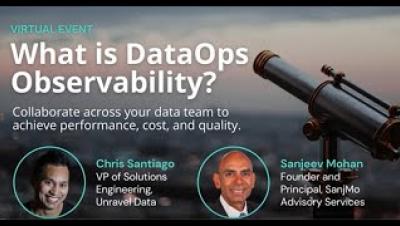
What is DataOps Observability?

Data teams like yours face new challenges as they manage an increasing variety of data formats, expanding use cases, and as data volumes double every three years. Organizations increasingly depend on new data products to meet their financial objectives. Join SanjMo Advisory Services Co-Founder Sanjeev Mohan and Unravel Data Vice President of Solutions Engineering Chris Santiago to learn.

What's Ahead in Data Management in 2023?

Data management is fundamental to every application. Managing this precious asset is an essential competency in modern businesses of every sort. Innovations in data platforms are being adopted, and data management approaches are evolving rapidly to keep pace. Increasingly, enterprises are converging their data warehouse, data lake, and other data management platforms onto distributed cloud-native infrastructures. As more types of data are consolidated into their platforms, enterprises implement more scalable DataOps pipelines and more comprehensive governance practices to manage it all.

Webinar Recording: Accelerating Cloud Data Modernization

As organizations seek to become more competitive, they are often looking to enrich their data sets for analytics to gain deeper insights. The data used for enrichment may include text data, machine data, image data, geospatial data, and real-time data. This data may be high volume, highly diverse, and disparate in nature. As part of this effort, organizations are moving to cloud data platforms to store and manage this modern data.