Systems | Development | Analytics | API | Testing

Enterprise AI Infrastructure Security Series - 3) Configuration Governance with Administrator Vaults

Securing ClearML for the Enterprise — Part 3: Configuration Governance with Administrator Vaults In this video we walk through ClearML's vault system — how personal vaults and administrator vaults work, and how administrator vaults let you enforce platform-level policies on storage locations, container images, and credentials across your teams and service accounts. What we cover.

How ClearML Helps Optimize Resource Allocation Across AI Workloads

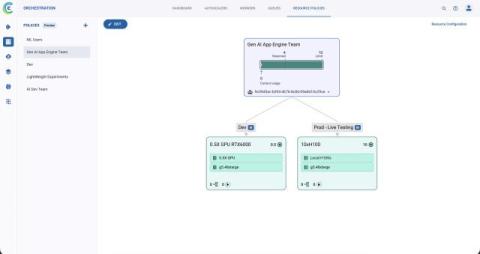
Author: Adam Wolf Efficient resource allocation is a foundational requirement for scaling AI workloads, particularly as organizations move from isolated experiments to shared infrastructure supporting multiple teams, models, and environments. GPUs, CPUs, and high-performance storage are costly and finite, and without coordination, utilization often degrades as usage grows.

Enterprise AI Infrastructure Security Series - 2) Identity Provider Setup, Group Sync & Access Rules

In this video we walk through setting up and testing an identity provider (Azure Entra ID) with ClearML Enterprise, enabling group synchronization to automate user onboarding, and then using platform access rules to secure the resources available to your teams and agents. What we cover: This is Part 2 of our series on enterprise AI infrastructure security.

Enterprise AI Infrastructure Security Series - 1) Intro

Welcome to Part One in this series covering AI Enterprise Security with ClearML. How do you secure an AI platform, ensure compliance, and still give your teams the access they need to move fast? ClearML builds security, compliance, and cost control into every layer of the platform — the guardrails are invisible to your AI/ML teams, but not absent. In this video, I introduce the six layers of the ClearML Enterprise security stack: Identity & Access, Configuration Governance, Automation Security, Compute & Data Access Governance, Model Serving, and Audit & Compliance.

ClearML Enterprise v3.28: Usage Metering, Policy Enhancements, and Smarter Admin Controls

Author: Adam Wolf ClearML Enterprise v3.28 offers new features and improvements to help administrators monitor usage, enforce policies, and streamline operations across large, multi-team environments. This release introduces enhanced usage metering with a simplified interface, improved resource policy management, improved dataset controls, and UI enhancements to provide greater clarity, control, and productivity for AI teams.

Multi-Node Training with ClearML

Orchestrating distributed AI workloads Distributed (multi-node) training has become a requirement rather than an optimization for many modern AI workloads. As model sizes grow, datasets expand, and training timelines tighten, teams increasingly rely on multiple machines, often with multiple GPUs each, to complete training efficiently.

Why ClearML's AI Application Gateway is a Critical Layer for Secure, Scalable AI Development Environments

As organizations expand their AI initiatives, they increasingly need to provide users, be they data scientists, AI/ML engineers, researchers, or application developers, with secure access to interactive development environments such as JupyterLab, VS Code, or other internal tools.

Inside ClearML's AMD Instinct GPU Partitioning Integration: Architecture, Orchestration, and Resource Management

GPU underutilization costs enterprises millions annually, with expensive accelerators frequently running single workloads at a fraction of their capacity. According to ClearML’s 2025-2026 State of AI Infrastructure at Scale report, almost half (49.2%) of IT leaders at F1000 companies identified maximizing GPU efficiency across existing hardware, including shared compute and fractional GPUs, as their top priority for expanding AI infrastructure over the next 12-18 months.

Run Slurm Workloads Inside Kubernetes With ClearML

By Erez Schnaider, Technical Product Marketing Manager, ClearML Slurm has powered HPC environments for years. It is battle tested, widely adopted, and deeply embedded in research and engineering workflows. Over 60% of the TOP500 supercomputers use it to manage their large infrastructure, orchestrate workloads and schedule jobs, as it is powerful and versatile with over 20 years of engineering behind it.