Systems | Development | Analytics | API | Testing

AI and Machine Learning: how are they changing the mobile testing landscape?

By incorporating AI and machine learning into mobile testing tools, teams can become more efficient in test automation. In this article, we'll look at how the adoption of AI and machine learning will improve these tools and what the future of testing might look like.


Feature Engineering for Modern Data Teams

Feature engineering is a crucial part of any ML workflow. At Continual, we believe that it is actually the most impactful part of the ML process and the one that should have the most human intervention applied to it. However, in ML literature, the term is often overloaded among several different topics, and we wanted to provide a bit of guidance for users of Continual in navigating this concept.

Preventing Customer Churn with Continual, Snowflake, and dbt

In this article, we’ll take a deep dive into the customer churn/retention use case. This should contain everything needed to get started on the use case, and enterprising readers can also try this out for themselves in a free trial of Continual, following the customer churn example in the linked github repository.

Choosing the Right Evaluation Metric

Is your model ready for production? It depends on how it’s measured. And measuring it with the right metric can unlock even better performance. Evaluating model performance is a vital step in building effective machine learning models. As you get started on Continual and start building models, understanding evaluation metrics helps to productionize the best performing model for your use case.

The state of iPaaS in 2022: Powering SaaS, Data Intelligence, and AI

The iPaaS market is clearly growing now at a faster pace than ever anticipated. This is not only due to the pandemic forcing companies to accelerate the digital transformation, but also in general due to the rise of SaaS. The replacement of older, server-bound software solutions with more modular, user-friendly and flexible SaaS solutions means customers need to connect these disparate cloud systems somehow if they want their business to become truly data driven.

Make the Leap to AI Driven Data Applications

The start of a new year is a perfect time to reflect on what was accomplished and look forward, re-evaluate what we can do better. Change, although difficult at first, can also be very rewarding. That’s why I was excited to see similar sentiments shared at Thoughtspot beyond.2021 to move beyond the traditional dashboards of the past.

Growing AI Fast with ML-Ops: Breaking the barrier between research and production

AI models get smarter, more accurate, and therefore more useful over the course of their training on large datasets that have been painstakingly curated, often over a period of years. But in real-world applications, datasets start small. To design a new drug, for instance, researchers start by testing a compound and need to use the power of AI to predict the best possible permutation.

Building an MLOps infrastructure on OpenShift

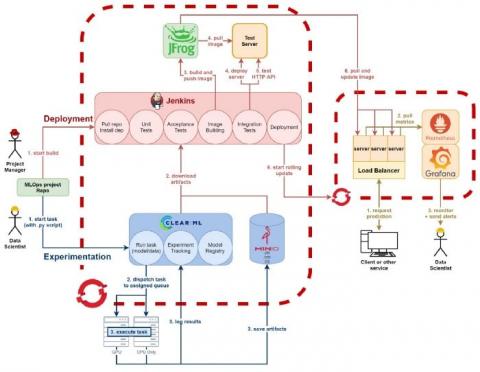
Most data science projects don’t pass the PoC phase and hence never generate any business value. In 2019, Gartner estimated that “through 2022, only 20% of analytic insights will deliver business outcomes”. One of the main reasons for this is undoubtedly that data scientists often lack a clear vision of how to deploy their solutions into production, how to integrate them with existing systems and workflows and how to operate and maintain them.