Systems | Development | Analytics | API | Testing

From Scripts to Systems: Why Enterprises Are Transitioning to Autonomous Testing

Every enterprise engineering leader knows the frustration of a stalled delivery pipeline. You push a minor user interface optimization or rename a single CSS utility class, and suddenly, a stable deployment build turns red. Hundreds of automated test scripts break instantly, not because the application logic failed, but because a static element locator changed. This is the reality of modern software delivery.

How to curate observability data for AI agents

Most debugging agents fail not because the model is wrong, but because the data going in is not ready for machine consumption. Here's what data curation actually looks like in practice. When we started building Multiplayer's debugging agent, we made the same mistake almost everyone makes. We gave our coding agent access to observability data and expected it to figure out what was relevant. It didn't.

Inference Is the New Bottleneck: How to Plan GPU Capacity for Production AI

Most enterprises sized their AI infrastructure with a playbook written for training. However, training is no longer the typical workload. Inference now eats up roughly two-thirds of all AI compute, and it is changing shape fast enough that the rules of thumb from 18 months ago just do not hold. Our view at ClearML is pretty simple: when the workload shifts this much, the platform underneath it has to shift with it.

Ep 79 | Why Some AI Products Strike a Chord (and Others Don't)

You recognize the tune, but something feels off. That's how Marlon Davis describes many of today's AI initiatives: AI karaoke. Organizations are rushing to add AI to products, but too often they're layering technology onto solutions without fully understanding the customer problems they're trying to solve. In this episode of The AI Forecast, Paul Muller sits down with fractional Chief Product Officer at Devlnio, Marlon Davis, to explore how organizations can move beyond superficial AI efforts and build products that deliver meaningful customer value.

Agentic apps that go beyond chat

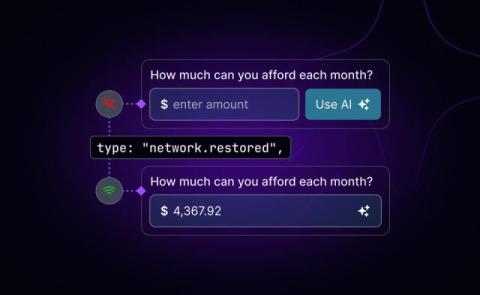
You are planning a trip with an AI assistant on your laptop. You are chatting with the agent, and as you progress it is dropping pins on a map, building a day-by-day itinerary, adding up a budget, and streaming its reasoning as it goes. The state of your interactive session is a combination of the chat history, the synthetic UI constructed by the agent during that process, and structured state, the itinerary, arising from the decisions you each make.

How Booking.com Scaled Agentic Analytics for Self-Service

At Snowflake Summit '26, Chris de Groot, Manager of Data Engineering Customer Service, and Jay Stricks, Group Product Manager, Insights Platform, took the stage to share Booking.com's massive data transformation. In their session, "Booking.com's Data Travels: Platform Foundations to Agentic Analytics," they laid out a masterclass on how to make a colossal, fragmented data landscape entirely AI-ready.

Moving from Probabilistic Reasoning to Deterministic Execution

Generative AI systems do not fail because models are weak. They fail because architectures are incomplete. Once organizations accept that prompts cannot guarantee reliability, a new challenge emerges: how to design systems that systematically convert successful AI behavior into repeatable, governable, and auditable workflows.

How to Measure Embedded Analytics ROI for Busy End Users

Most analytics programs fail the ROI test for one simple reason: they measure dashboard output, not workflow impact. A team can ship reports, charts, and alerts, yet still miss the real question: does the analytics change what busy people do next? That is the core issue for embedded analytics ROI. How do we measure whether embedded analytics actually delivers business value for busy end users, frontline teams, and executives?

How Enterprise Teams Are Keeping Up With AI-Generated Code at Scale | Perforce 2026

When AI Starts Shipping Code: Managing the Collision Between Human and AI-Generated Code AI agents don't wait for reviews. They generate code overnight, work across the same codebase in parallel, and produce more changes than any human team can realistically process — creating a new kind of bottleneck we call the Merge Wall. In this session, Perforce engineering leaders break down what happens when human and AI-generated code collide at scale — and how leading teams are building the visibility, governance, and coordination layers required to keep up.