Systems | Development | Analytics | API | Testing

How Xray Connects Quality Across Teams

Delivering high-quality software is not only about testing thoroughly. It is about connecting people, tools, and workflows so that quality becomes a shared goal. Developers, QA engineers, and product teams each play a role, but when their efforts are disconnected, quality suffers. When testing is isolated from development or requirements management, visibility disappears. Bugs slip through. Releases slow down. Product decisions become harder to validate.

Edit and delete messages without rewriting your history layer

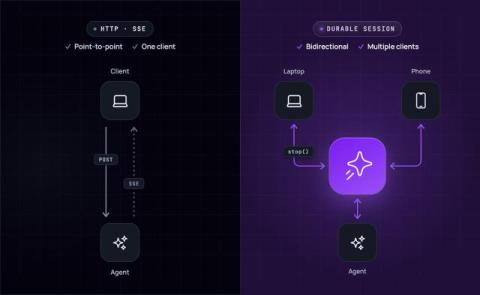
Editing or removing a message after it’s been published sounds simple. In realtime systems, it usually isn’t. Once a message has been delivered to multiple clients, cached locally, and written into history, changing it safely becomes a coordination problem. Clients need to agree on what’s current. History needs to stay consistent. Reconnects and refreshes can’t bring back stale content. That’s why many systems treat messages as immutable by default.

AI Data Gateways & Data Governance: Scaling Trustworthy LLM Agents

As AI agents move from prototype to production, organizations face a growing paradox: how to give these agents enough access to unlock business value—without compromising privacy, compliance, or control. This isn’t just an integration problem. As soon as you map API layers or ask how a generative agent might retrieve sensitive customer records, the challenge becomes one of governance, scale, and trust.

DLP, Traffic Replay, and the Missing Link to Software Quality

In Part 1 and Part 2 we explored why testing modern software is so difficult. Production data is the most valuable input for testing, but it’s locked away because it contains PII and sensitive context. Traditional Synthetic Data Generation (SDG) was built for batch databases, not streaming systems. And AI coding agents amplify every weakness in existing test strategies because they need current, realistic data or they generate buggy code based on outdated assumptions.

How AI Coding Is Breaking Synthetic Data Generation

Traditional synthetic data generation approaches, still called “Test Data Management” (TDM) by legacy vendor, were designed for a world where applications were monolithic, databases were the center of gravity and change happened slowly. The world looks a lot different now. Modern systems are distributed, often times event-driven, and increasingly powered by streaming data and AI agents. In this environment, batch-oriented synthetic data generation fails to capture how systems actually behave.

Why Your Company Will Be Running OpenClaw Next Year

You’ve probably heard of OpenClaw. Maybe you’ve seen the demos where an AI agent opens a browser, navigates to your CRM, fills in a form, and files a support ticket. No API required. Maybe you thought “that’s cool but I’d never run that at work.” Your employees already are. According to Permiso’s research, 22% of enterprise customers have employees running OpenClaw without IT approval.

insightsoftware Data + Analytics Wins 2025 Dresner Technology Innovation and Application Innovation Awards for Embedded BI

For the fifth consecutive year, Dresnor Advisory Services has recognized insightsoftware Data + Analytics as a top Embedded Business Intelligence solution. This year’s dual recognition, winning both the 2025 Technology Innovation Award and 2025 Application Innovation Award, reinforces Logi Symphony’s position as the market’s premier solution for embedding analytics directly into applications.

5 Lessons learned building a web application crawler

Building a web application crawler came with plenty of challenges—here’s what we learned. Recently, we built a web application crawler from scratch—which had some scratching their heads, asking why we’d undertake such a thing. Here’s our answer to that, plus some interesting technical challenges we ran into and how we tackled them.

How to Choose Between Server-Side and Web-Based Reporting

Any time an organization closes the books or practices the governance needed to meet regulatory demand, it relies on reporting. Reporting technology is designed to save time while increasing accuracy, but many long-standing reporting vendors are existing or de-emphasizing this still-essential space. This leaves a gap for teams that need a modern, production-grade reporting solution. And when choosing between reporting tools, architecture is important.

Chrome Developer Tools: The Ultimate Overview

Chrome developer tools, or Chrome DevTools, give us a window on how our websites working in the wild. Built for developers of all experience grades, they provide powerful ways to inspect, debug and optimize our projects. However the sheer breadth of functionality can be a mind-melt if you’ve not worked with DevTools before, and there are lots of advanced features that even experienced users find tricky.