Systems | Development | Analytics | API | Testing

The Friction with Today's Debugging Strategies

Debugging has always been part of the craft. But in today’s systems — distributed, asynchronous, and increasingly opaque — debugging is no longer just difficult. It’s fragmented. Despite better tooling, more telemetry, and the rise of AI-assisted workflows, many developers still experience the same core frustrations when trying to understand what’s actually happening in production.

Automatic Sourcemap Retrieval in Production: Debugging Without the Friction

If you’ve ever debugged a Node.js application in production, you’ve likely seen this: Sourcemaps were supposed to solve this. And technically, they do. But in practice, most teams still struggle to make sourcemaps available when they’re actually needed.

A Better Streams Model for JavaScript Is Taking Shape

If you’ve worked with Node.js in production, you already know that streams are not a niche feature. They are part of the foundation. They power how data moves through systems, how I/O is handled, and ultimately, how applications scale. For years, that foundation has held up remarkably well. At the same time, many developers—junior and senior alike—have shared a similar feeling: while streams are powerful, they don’t always feel natural to work with.

Anthropic Accidentally Leaked Claude Code's Entire Source - Here's What Was Inside

On March 31, 2026, security researcher Chaofan Shou noticed something odd: the complete source code of Claude Code — Anthropic's flagship AI coding CLI — was sitting in plain sight on the public npm registry. 512,000 lines of TypeScript. 59.8 MB of source maps. Everything. The irony? The code contains an "Undercover Mode" specifically built to prevent internal Anthropic secrets from leaking into public commits. They built a secrecy subsystem, then accidentally published everything.

Why Node.js Upgrades Are Still Hard - And How OpenJS + NodeSource Are Addressing It

In today’s ecosystem, building with Node.js is not just about writing code. It’s about running systems that are reliable, secure, and able to evolve over time. That’s where collaboration at the foundation level becomes critical. At NodeSource, working closely with the OpenJS Foundation is not just a partnership. It’s a commitment to the long-term health, security, and evolution of the Node.js ecosystem.

JavaScript Is Evolving Faster Than Ever - And JSConf Spain Made It Impossible to Ignore

There’s something powerful about stepping away from your day-to-day work and being surrounded by people asking the same questions you’ve been thinking about: At JSConf Spain, those answers don’t come from a single talk. They emerge from patterns — ideas that repeat across different speakers, different companies, and different perspectives.

Scan, Analyze, Execute: NodeSource's Three-Step Workflow for Stress-Free Node.js Migration

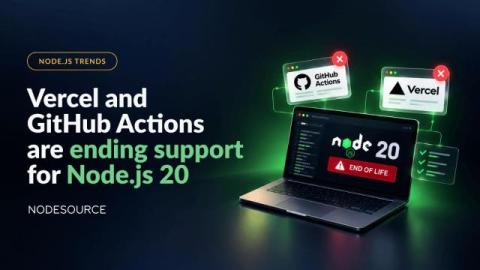
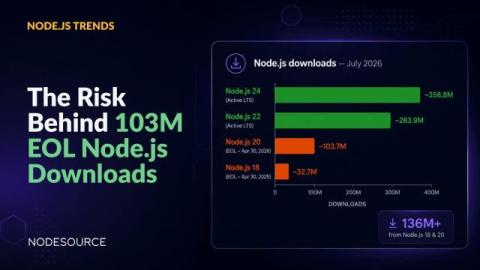
Today marks a critical step forward for enterprise Node.js. In partnership with the OpenJS Foundation, NodeSource is launching a Node.js LTS Upgrade & Modernization program to provide companies with a secure and streamlined path to migrate business-critical applications off legacy and End-of-Life (EOL) Node.js versions and onto the latest Long-Term Support (LTS) releases.

February in Node.js: Release Discipline, Security Signal, and Runtime Progression

February was not defined by major feature drops. It was defined by process hardening, structured release cadence, and continued runtime iteration across both LTS and Current lines. For production teams, this month reinforced three pillars: This is the technical breakdown of what actually mattered.

Inside the Node.js Event Loop: What Actually Blocks Your Production System

Your service doesn’t crash. It just gets slower. Latency creeps up. Requests that used to take 20ms now take 120ms. p99 drifts. Throughput drops slightly. Nothing is obviously broken — but the system feels congested. You open your dashboards. And yet, something is clearly off. In many production systems, this is what Event Loop pressure looks like. Not a failure. Not an outage. But a runtime that is struggling to make forward progress. The JavaScript thread is not dead. It’s busy.

Is Node.js Single-Threaded... or Not?

You’ve probably heard: “Node.js is single-threaded.” That statement is only partially correct. The JavaScript engine (V8) is single-threaded. Node.js as a runtime is not. Under the hood, Node.js uses multiple threads — through libuv and the operating system — to handle I/O and computationally expensive work. So the real question isn’t whether Node.js is single-threaded. It’s.