Getting Started With Kong Konnect in 10 Minutes
In this Kong Konnect tutorial, you’ll learn how to leverage the platform to manage your API ecosystem from a single easy-to-use interface.


In this Kong Konnect tutorial, you’ll learn how to leverage the platform to manage your API ecosystem from a single easy-to-use interface.
Greg Peranich and Tryn Brown contributed to this post. The world of financial services is driven by digital experiences. Over the last 20 years, virtually all banking activities have been taken online (an unfortunate change only for fans of pneumatic tubes and pens on beaded chains). Like other industries that have undergone digital transformation, financial institutions are leveraging APIs to give users a more seamless experience when managing their money.
The release of Kuma 2.3 brings experimental support for GAMMA (Gateway API for Mesh Management and Administration) resources. Kuma has long supported Gateway API with the built-in gateway for ingress traffic but with GAMMA support, users can specify how to route and modify in-mesh traffic using the well-known HTTPRoute resource from Gateway API. Gateway API is a project focused on improving the APIs around networking between services in Kubernetes clusters.
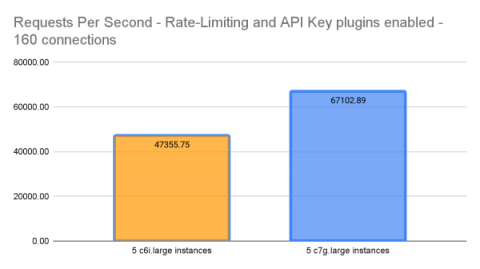
Today, we’re thrilled to announce that Kong Enterprise and Kong Konnect Data Planes are now validated to run on AWS Graviton3 processors and Amazon Linux 2023 OS. As an APN Advanced Tier Partner of AWS, we were delighted to have the opportunity to benchmark Kong Enterprise running on AL2023 and Graviton3.
Kong is proud to announce the release of the latest version of Kong Mesh 2.3. In this release, Kong Mesh continues to build upon the enterprise-grade service mesh in the critical areas of, security, flexibility, and resiliency. As organizations continue to leverage APIs to deliver digital experiences they rely more heavily on the underlying infrastructure that a mesh provides.
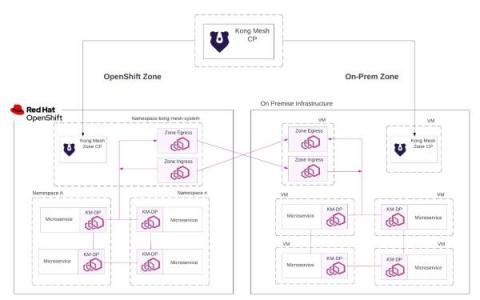
By now, when we hear the words “service mesh” we typically know what to expect: service discovery, load balancing, traffic management and routing, security, observability, and resilience. So, why Kong Mesh? What does Kong Mesh offer that would be more difficult to obtain with other solutions? Why is Kong Mesh with Red Hat OpenShift a great pairing? We’re happy to announce that the Kong Mesh 2.2.0 UBI Images are available in the Red Hat Ecosystem Catalog.
API monetization is currently a trending topic for many organizations looking to beef up their revenue. Of course, monetizing APIs isn’t the easiest of tasks and requires quite a few moving parts. When it comes to monetization, you’re going to need an entire technology stack to handle the heavy lifting. Creating a stack that allows you to build a product and get to market rapidly is great.
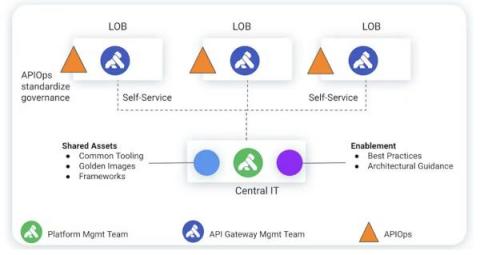
Enterprises are investing in data mesh initiatives to accelerate how decisions are made and to create novel experiences based on machine learning models. Similarly, enterprises are investing in API platform initiatives to productize business domains (or bounded contexts in domain-driven design parlance) as self-service digital assets that accelerate innovation and improve business agility. Both initiatives are typically run as separate work streams.
We’ve just shipped Kong Ingress Controller (KIC) 2.10! This release makes KIC easier to use. In this blog we’ll cover: You can read the CHANGELOG for full details, but for now, let’s focus on the highlights.
If you’ve been researching API security, you’ve likely seen the term “Zero Trust.” And you may already know that organizations can use Zero Trust to help protect their APIs from attacks. What you may not know is that Zero Trust is one of the best models for API security. According to Microsoft, “96 percent of security decision-makers state that Zero Trust is critical to their organization’s success.” But what is Zero Trust exactly?