Kuma is configurable through policies. These enable users to configure their service mesh with retries, timeouts, observability, and more. Policies contain three main pieces of information: Kuma 2.0 introduces a new matching API that’s more understandable and powerful. In this article, we explain why we’re doing this, how to use the new policy matching API, and what’s coming next.
We’re excited to announce the general availability of Kong Insomnia 2022.7. This update brings several new capabilities into the fold with a focus on improving API quality and driving productivity. Read on to learn more about what’s new in Kong Insomnia.
IBM recently announced the deprecation of its Cloud API Gateway, a service used to create and manage APIs by placing a gateway in front of existing IBM Cloud endpoints. With this move, IBM Cloud Functions and IBM Cloud Foundry are no longer able to use Cloud API Gateway service for rate limiting, splitting, and authentication.
Security Assertion Markup Language (SAML) is an XML-based open standard that allows organizations to set up single sign-on (SSO) across multiple websites and applications. SAML 2.0 is the latest standard, and was ratified in March 2005, replacing SAML 1.1. We’ll refer to SAML as meaning SAML 2.0 for the remainder of this document. SAML is mostly used as a web-based authentication mechanism as it relies on using the browser to broker the authentication flow.
We’re excited to announce the general availability of Kong Enterprise 3.1. In Kong Enterprise 3.1, we build on the foundation of our plugin ecosystem by introducing five new plugins and enhancing the functionality of existing ones. These include: We’ll explore the ins and outs of each of these plugins below. But first let’s talk about why plugins are such an important part of Kong’s solutions.
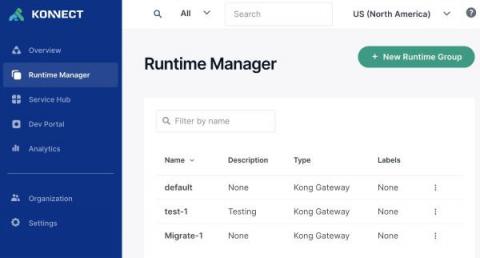
We’re excited to announce new features in Kong Konnect that are designed to increase security and streamline API management. Read on to learn more about what’s new in Kong Konnect.
As an application developer, have you ever had to troubleshoot an issue that only happens in production? Bugs can occur when your application gets released into the wild, and they can be extremely difficult to debug when you cannot reproduce without production data. In this blog, I am going to show you how to safely send your production data to development applications deployed using a service mesh to help you better debug and build production proof releases.
Kong connects APIs and microservices natively within clouds, data centers, and Kubernetes platforms using intelligent automation. Built on an open source core, Kong’s solutions enable digital innovation by allowing organizations to reliably and securely manage the full lifecycle of APIs for legacy as well as modern architectures, including container runtimes and serverless technologies.