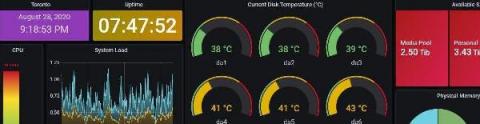
In our guide on the best Grafana dashboards examples, we wanted to show you some of the best ways you can use Grafana for a variety of different use cases across your organisation. Whether you are a software architect or a lead DevOps engineer, Grafana is used to make analysis and data visualisation far easier to conduct for busy engineering and technical teams throughout the world.
In the past few years, JavaScript has evolved in several ways and has come a long way. With the evolving technology, machines are becoming more powerful, and browsers are getting more robust and compatible. In addition, Node.js’s recent development for JavaScript’s execution on servers, JavaScript has been getting more and more popular than ever before.
Commonly, your website or app functions perfectly until you release it. During testing, you might seem to have control over everything. But, sooner or later, you will face some challenges. In fact, it is totally normal when something goes wrong. The most important thing is how you settle these problems. In most cases, issues with availability alerts and users’ complaints can be addressed by the means of IIS logs. IIS logging will provide you with the necessary data to deal with a breakdown.
Welcome to the summer Bugfender newsletter! This quarter we’re planning a roadmap of new features and improvements to come we hope you’ll love. Crash aggregation is one of these features that will come soon to Bugfender, providing a bigger picture of your app’s crashes. Also, we’ll be doing some major UI/UX improvements to the app, since Bugfender has grown to a more mature state, and we want to keep improving the app’s usability.
Flutter is a user interface toolkit from Google which is primarily used to develop mobile applications but can also be deployed to create web and desktop apps. With Flutter, we can develop applications for both IOS and Android using the same source code. This dovetails neatly with Bugfender, our remote logging service that allows users to collect logs for everything in the application.
When we speak to our customers, they tell us that Bugfender is great for capturing application logs and then pinpointing the logs of a specific user. By pulling all the logs from a developer’s mobile and web apps and centralizing them in a single dashboard, Bugfender gives that developer a 360-degree sweep of their entire user base. But what if you want to use this data somewhere else? What if you could provide this data within an Elasticsearch database?