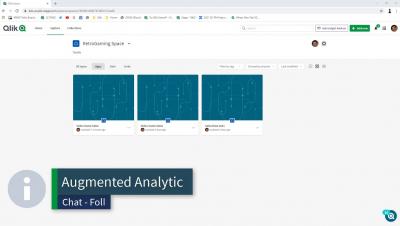
What's New - February 2021 - Feature Demonstration
A collection of the more demonstrable features in Qlik Data Analytics release February 2021.


Every new decade sees businesses split into winners and losers as technology evolves, competitiveness tightens, and new market entrants challenge the incumbents.
Thanks for all those who enthusiastically responded to my first blog post on Qlik analytics with Peloton! Now, onward brave souls as we learn HOW I was able to create the analytics I wrote about earlier!
As a result of overwhelming excitement (and pressure) from my fellow Qlikkies, I’m going to share with you the recent demo I did at our all-company annual kick-off which shows Active Intelligence in action. It was intended to be an “internal-only” demo because it mixes existing capabilities with near-term future ones, but, on reflection, I think you, too, will be just as excited.
Throughout 2020, a challenging year for so many in our community, Qlik remained laser-focused on delivering groundbreaking and transformative innovations across our portfolio.
I’m a geneticist, which is really just a technical way of saying that I obsess about the minutiae of your family history. Now, while that sounds rather stalkerish, this is in fact a molecular and data-driven addiction, which is fuelled by my need to understand the nature of evolution and human behaviour via the data within our DNA. Our genomes are the single-most densely packed dataset that we have ever encountered.
The wait is nearly over, and soon we’ll all be privy to this year’s Gartner Magic Quadrant for Analytics and BI Platforms. Qlik is proud of its 15-year history and ranking as a leader for the last decade in this signature research, and we are enthusiastic about sharing a complimentary copy of the full report when it publishes at this location: https://www.qlik.com/us/gartner-magic-quadrant-2021
Before the end of the year, I met with Christina McCoy, a Customer Success Manager for our federal region. We discussed some of her observations and proven practices for driving adoption in her accounts. Christina joined Qlik two years ago; she has over five years of CSM experience and is a graduate of Howard University, where she was a pitcher for the Bison’s softball program.
Ok, I’ll admit it… I’m one of those people, I own a Peloton – and it’s awesome. But, as a data professional, I’ve struggled with getting decent metrics about how I’m doing and trying to see if I’m making progress with my fitness level. How can I discern performance stats to answer basic questions to gauge my performance over time?
On December 8th, it was time for the annual “State of the Union” from Qlik, with regards to BI & Data Trends. Overwhelmingly, attendance was in the many thousands, and we received thousands of questions. To get that type of engagement in a year where people have done nothing but virtual conferences is amazing. One person put it to me like this: “I just joined in on your webinar on the top data and analytics trends and it was truly fantastic.