

Serverless computing is an exciting alternative to hosting apps on the AWS cloud. In this four-part series, we’ll run through how to build AWS Lambdas with TypeScript, improve the dev experience, optimize it, and finally, use AWS Cognito for security. In this take, I would like to take you on a journey to explore AWS Lambdas using TypeScript. We will build a pizza API, use Claudia to help deploy the app, and use the AWS CLI tool to set up a DynamoDB database.
An application monitoring tool (APM) is not just useful for seeing how your application performs through graphs and visuals. We can go deeper and use an APM to understand how your application behaves in a certain environment. As developers, we should aim to be less reactive to errors and more predictive, avoiding crashes for end-users. One way to accomplish this is by using monitoring tools to debug our application when an error occurs.
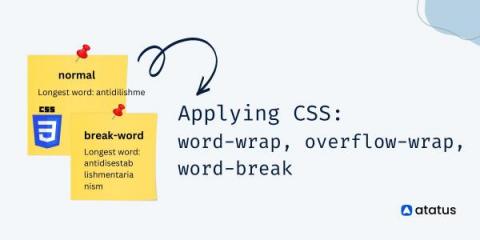
A website's responsiveness is very significant these days in order to display correctly on all devices. Although you may try your best, broken layouts may still occur despite your best efforts. Long words can be broken and wrapped to the next line when you use the CSS word-wrap property. A string being too long can overflow a container in most cases, so this method can be helpful in preventing overflow.
Elixir v1.14 shipped earlier this month with a bunch of new goodies. In this post, we'll explore Elixir's new PartitionSupervisor. We'll take a look at some code that suffers from the exact bottleneck issue that partitions supervisors are designed to solve. Then, we'll fix that bottleneck. Along the way, you'll learn how partition supervisors work under the hood to prevent process bottlenecks. Let's get started!
Product retention is an extremely important metric to check the health of your business. Calculating the retention rate of your business will return the percentage of users who continue using your product or service over a given time period. Retention can really be seen as a gauge for customer loyalty and a good reflection of the quality of your customer relationship with a new or existing customer.
Is it enough? The data we consume in our homes and businesses continues to grow at a blistering pace. Internet of Things (IoT) device connections are also increasing exponentially, with the average number of devices per connected home more than doubling just over the past couple of years. To address all of this growth, service providers are continuously expanding their fiber to the premise (FTTP) and hybrid fiber-coax (HFC) footprint.