Systems | Development | Analytics | API | Testing

The European Health Data Space (EHDS): From Regulation to Reality

The European healthcare landscape is undergoing its most significant digital transformation in decades. We are moving away from a fragmented era where health data was locked within the walls of individual hospitals and national borders. In its place, the European Health Data Space (EHDS) is emerging, a unified digital ecosystem designed to give patients control over their data and unleash its potential for research and innovation.

Kong Simplifies Multicloud Cloud Gateways with Managed Redis Cache

As enterprises race to deploy multicloud architectures and Agentic AI, they face a common bottleneck: "state." To govern AI token usage, manage agent-to-agent communication, or optimize performance via caching, API and AI gateways require a persistence layer to synchronize data. We’re excited to share the GA of Managed Redis cache for Kong Dedicated Cloud Gateways (DCGW).

Configuring Kong Dedicated Cloud Gateways with Managed Redis in a Multi-Cloud Environment

A persistent challenge arises as businesses adopt multicloud architectures and agentic AI: the need for state synchronization. API and AI gateways require a robust persistence layer to synchronize data, whether it's for governing AI token usage, facilitating agent-to-agent communication, or boosting performance through caching.

Leveraging the MCP Registry in Kong Konnect for Dynamic Tool Discovery

As enterprises start deploying AI agents into real systems, a new architectural challenge is emerging. Agents need a reliable way to discover tools, services, and capabilities dynamically, instead of relying on hardcoded integrations. This is where the Model Context Protocol (MCP) ecosystem is rapidly evolving. MCP servers expose tools and capabilities that AI agents can use. However, once organizations begin deploying multiple MCP servers across environments, the question becomes clear.

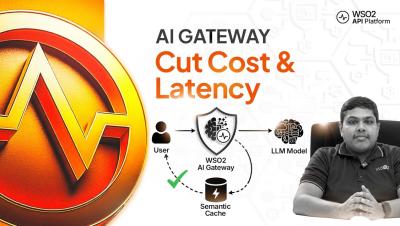
WSO2 AI Gateway: Prompt Management & Semantic Caching

Learn how to ensure consistent AI interactions and drastically reduce latency using the WSO2 AI Gateway. This step-by-step tutorial demonstrates how to standardize your LLM requests for quality and efficiency while cutting down on redundant API costs. We explore "Prompt Management" to enforce organizational guidelines using templates and decorators, and "Semantic Caching" to leverage vector embeddings—serving instant, cached responses for semantically similar queries to minimize expensive LLM calls.

How AI Is Redefining Route Optimization to Enable Faster Deliveries?

When executives talk about improving logistics performance, the conversation often circles around the same three goals: speed, cost efficiency, and reliability. Yet the reality on the ground tells a different story. Traffic congestion, rising fuel costs, driver shortages, changing customer expectations, and unpredictable disruptions continue to make route planning one of the most complex operational challenges in logistics. Now add one more pressure point: customer expectations have fundamentally changed.

The Breakdown | API calls and mobile apps

You used an API this morning. Probably before you even got out of bed. That weather app? It's your phone communicating with a server in the cloud — sending a request, getting data back, and displaying it on your screen in seconds. Location. Request format. Expected response. That's the anatomy of an API call. And it's happening constantly across nearly every app on your phone. Hugo Guerrero and Amanda Alcamo break it all down in Episode 2 of The API & AI Breakdown. No jargon. No fluff. Just clarity.