Systems | Development | Analytics | API | Testing

Embed Quality to Ensure Regulatory Compliance in FinTech Solutions

This article originally appeared on Software Testing News. We’re sharing it here for our audience who may have missed it. An overlooked API can expose customer data, trigger multi-million-dollar fines, and sink a FinTech product launch. And now, the FinTech industry is at a crossroads, driven by innovation yet bounded by intensifying regulatory demands.

Why API-First Matters in an AI-Driven World

APIs have long been the backbone of modern software systems, architectures, and businesses. They now dominate the web, accounting for 71% of all internet traffic. Generative AI is accelerating this trend especially as we pivot our interaction with common web-based capabilities, like “search” in favour of AI-enriched variants. More AI leads to more APIs, and with that, APIs act as an important mechanism to move data into and out of AI applications, AI agents, and Large Language Models (LLMs).

Build Your Own Internal RAG Agent with Kong AI Gateway

RAG (Retrieval-Augmented Generation) is not a new concept in AI, and unsurprisingly, when talking to companies, everyone seems to have their own interpretation of how to implement it. So, let’s start with a refresher. RAG (short for Retrieval-Augmented Generation) is a technique that injects relevant data from an external knowledge source directly into a prompt before sending it to a Large Language Model (LLM). “But wait, my model is already fine-tuned on my domain-specific data.

Kong Gateway Enterprise 3.11 Makes APIs & Event Streams More Powerful

We’re excited to bring you Kong Gateway Enterprise 3.11 with compelling new features to make your APIs and event streams even more powerful, including: We’ll also touch on what’s new with Konnect networking and Active Tracing. There’s a lot to unpack, so keep on reading for the full story!

Kong AI Gateway 3.11: Reduce Token Spend, Unlock Multimodal Innovation

Today, I'm excited to announce one of our largest Kong AI Gateway releases (3.11), which ships with several new features critical in building modern and reliable AI agents in production. We strongly recommend updating to this version to get access to the latest and greatest that AI infrastructure has to offer.

Beyond console.log: Smarter Debugging with Modern JavaScript Tooling

Ask any JavaScript developer their most used debugging tool and chances are the answer will be console.log. It’s immediate, low friction, and available in every browser. For development, it’s fantastic. But for production and complex applications, if you rely on console.log alone, cracks begin to show. It lacks context, doesn’t persist, and makes reproducing or analyzing user-reported issues a challenge. In this article, we’ll look at smarter, scalable debugging strategies.

How to Avoid N+1 Queries in Django Python

Django is a powerful web framework that simplifies how developers interact with databases through its Object-Relational Mapping (ORM) system. However, even with its benefits, it’s easy to fall into performance pitfalls such as the N+1 query problem. In this article, we’ll explore what N+1 queries are, why they can be an issue for your application, and how to mitigate them using Django’s best practices. Let's dive in!

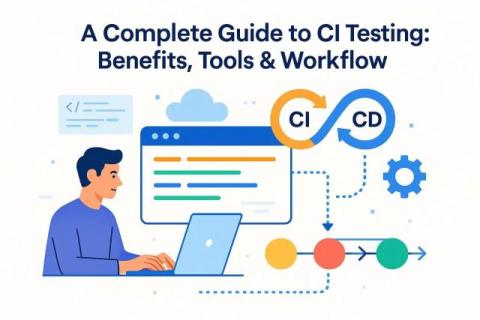
The Benefits of Continuous Integration: A Guide to Streamlining Your Business

DevOps is the delivery process that focuses on the cross-functional approach of building and shipping applications in a faster manner through automation of infrastructure, workflow as well as performance evaluation. One of the most essential components of DevOps is CI/CD, which acronym for continuous integration (CI) and continuous delivery (CD).

Blueprint for Enterprise GenAI: Governance, Gateways, and Guardrails

Generative AI is transforming how businesses operate, with 74% of enterprises already deploying it in production by 2025. The technology offers measurable benefits like a 1.7x ROI and cost reductions of 26–31% in key areas like supply chain and customer operations. But with rapid adoption comes serious risks - data breaches, AI bias, and compliance issues are top concerns.