

Systems | Development | Analytics | API | Testing

Will AI coding create more monoliths?

Let’s start with a statement everyone can agree on: AI coding is now a permanent fixture of the software development lifecycle. Even if your team hasn’t introduced it officially yet, it’s only a matter of time before one of your peers kicks off the discussion or pushes a PR that, perhaps even unbeknownst to you, is entirely AI-generated. Now, let’s rub some folks the wrong way: AI coding in a microservices architecture is a recipe for disaster.

Harnessing Global Perspectives for AI Industry Leadership

Besides a few initiatives, global efforts to address the unprecedented challenges and opportunities presented by AI remain fragmented. The recent "AI Safety Summit" provided a crucial opportunity to emphasize the importance of international perspectives to fully tap into AI's potential. It has helped guide the conversation around responsible AI development and governance, ensuring the benefits of AI are maximized while mitigating its risks.

Lack of Governance, Infrastructure Readiness, and IT Talent Leading to Enterprise GenAI Struggles: New Report

Nearly all organizations surveyed view GenAI as a top 5 priority, but just 44% have comprehensive governance policies in place. Organizations cite security, infrastructure, and data management as top barriers to adoption.

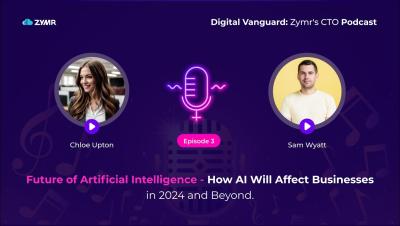
Episode 03: Future of Artificial Intelligence- How AI Will Affect Businesses in 2024 and Beyond.

In the latest episode of Digital Vanguard: Zymr's CTO Podcast, Chloe and Sam delve deep into discussions about Artificial Intelligence. Exhibiting Zymr's expertise in AI/ML, the discussion covers AI's transformative impact on various industries in 2024 and beyond. Sam highlights AI's role in enhancing operational efficiency, security, and personalization across sectors such as cloud computing, CRM, cybersecurity, e-commerce, fintech, and healthcare. For cloud computing, AI optimizes resource allocation and security.

16 Ways Insurance Companies Can Use Data and AI

There is a growing recognition that insurers can introduce data, analytics and AI into virtually all of the important insurance functions and workflows, including product development, pricing and risk selection, underwriting, claims management, contact center optimization, distribution management, reinsurance, and understanding and shaping customer journeys. Here are some of the exciting ways insurance companies can put data to work.

Commercial vs. Self-Hosted LLMs: A Cost Analysis & How to Choose the Right Ones for You

As can be inferred from their name, foundation models are the foundation upon which developers build AI applications for tasks like language translation, text summarization, sentiment analysis and more. Models such as OpenAI's GPT, Google's Gemini, Meta’s Llama and Anthropic’s Claude, are pre-trained on vast amounts of text data and have the capability to understand and generate human-like language.