Systems | Development | Analytics | API | Testing

Understanding ISO/PAS 8800 for AI in Automotive Safety

With the rise of AI use in vehicle software development, concerns arise around its presence in safety-critical applications, especially when it comes to functional safety and regulatory compliance. ISO 26262, the essential standard for automotive development that requires processes for managing, designing, and verifying safety-critical systems, still applies. However, it can fall short when applied to AI models, which are inherently non-deterministic and continuously evolving.

Hevo's Next Evolution

Every company has an AI roadmap. Very few have the data infrastructure to execute it. At Hevo Data, we've spent 8 years building pipelines that are reliable, simple, and transparent so 2,000+ data teams can build without second-guessing their data. We sat down with Manish Jethani, Amit Gupta, and Scott Husband to talk about what comes next. If your data isn't AI-ready, your roadmap stays a roadmap. We've re-engineered the platform to serve as the context engine your AI vision actually runs on. Because the models are only as good as the data underneath them.

Why 90% of AI Projects Never Leave the Pilot Phase? #ai #shorts #softwarearchitect

Struggling to scale your AI? You aren’t alone. Shafrine from WSO2 identifies the bottleneck holding companies back: Data Silos. Without integration, your AI agents lack the "context" needed to be useful in a production environment. Learn how to bridge the gap between a "cool pilot" and a "scalable enterprise agent" by fixing your fragmented workflows.

How Manufacturing Leaders Deploy AI Faster with Governance-First Architecture

AI workflows for manufacturing need to be deployed quickly. Quality control systems, predictive maintenance tools, and supply chain optimization algorithms may be going live, yet compliance infrastructure is lagging behind. The result is a familiar pattern: pilots that prove out technically but stall before production because they can’t clear audit, safety, or regulatory review.

Why Audit Logs Matter for AI Governance | DreamFactory

Audit logs are essential for making AI systems accountable, reliable, and compliant with regulations. They act as a record-keeping system, documenting every critical interaction within an AI system, such as user prompts, model decisions, and policy enforcement. Here's why they are crucial: Audit logs are not just a legal requirement - they are a key part of managing AI systems effectively and minimizing risks.

From Executors to Strategic Partners: The Evolution of Software Vendors in the AI Era

Artificial intelligence is transforming the global software industry. Some analysts refer to this shift as a “SaaS apocalypse,” with traditional software companies losing over a trillion dollars in market value. Historically, software vendors executed client visions by writing code. Now, as clients articulate their needs and AI generates code, the industry faces a critical question: What role remains for software vendors? This requires a fundamental shift.

Anthropic Accidentally Leaked Claude Code's Entire Source - Here's What Was Inside

On March 31, 2026, security researcher Chaofan Shou noticed something odd: the complete source code of Claude Code — Anthropic's flagship AI coding CLI — was sitting in plain sight on the public npm registry. 512,000 lines of TypeScript. 59.8 MB of source maps. Everything. The irony? The code contains an "Undercover Mode" specifically built to prevent internal Anthropic secrets from leaking into public commits. They built a secrecy subsystem, then accidentally published everything.

The Agent Era Has a Data Problem. Qlik Solves It.

It’s clear that we are in the early innings of an unparalleled shift in how knowledge work gets done across the board. If you pull forward the changes we’ve already seen from teams who have adopted agents in software development and apply them to broader categories of knowledge work, you can see how these patterns will lead to a fundamental rethinking of the relationship and responsibilities between humans, software, and data.

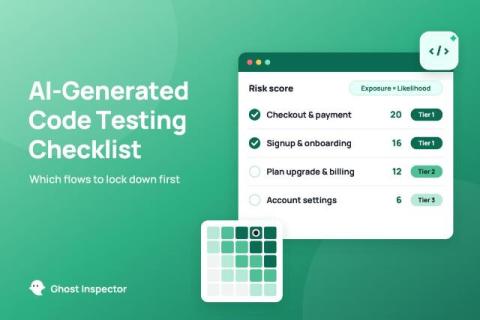
Why AI-Generated Code Needs AI-Powered Testing: The Validation Gap Developers Are Missing

You have an AI coding assistant open. You describe a function in plain language, it generates 40 lines of clean, well-structured code in under ten seconds, you review it briefly, it looks right, and you ship it. That workflow is now routine for millions of developers. The speed is real. The output looks authoritative. The problem is that looking right and being right are not the same thing.