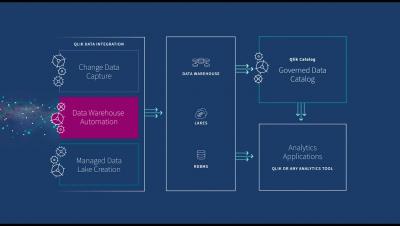
Welcome to Qlik Data Integration Platform
See how the Qlik Data Integration Platform helps streamline, automate, and accelerate your end-to-end data pipeline.

Many people think of Cloud Run just as a way of hosting websites. Cloud Run is great at that, but there's so much more you can do with it. Here we'll explore how you can use Cloud Run and BigQuery together to create an inventory management system. I'm using a subset of the Iowa Liquor Control Board data set to create a smaller inventory file for my fictional store. In my inventory management scenario we get a csv file dropped into Cloud Storage to bulk load new inventory.
Five major differences between Alteryx and Xplenty: Alteryx Analytics and Xplenty both offer no-code/low-code ETL solutions that simplify the process of extracting, transforming, and loading data. Nevertheless, there are distinct differences between Alteryx and Xplenty that could affect your decision to choose one over the other.
The growth of data has been exponential. By 2023, it's anticipated that approximately 463 exabytes (EB) will be created every day. To put this into perspective, one exabyte is a unit equivalent to 1 billion gigabytes. By 2021, 320 billion emails will be sent daily, many of which contain personal information. Data collected around the globe contains the type of information that businesses leverage to make more informed decisions.
Building a data lake in Amazon S3 using AWS Spectrum to query the data from a Redshift cluster is a common practice. However, when it comes to boosting performance, there are some tricks that are worth learning. One of those is using data in Parquet format, which Redshift considers a best practice. Here's how to use Parquet format with Xplenty for the best data lake performance.
It’s hard to believe that Unravel Data was founded eight years ago — though the first few years were dedicated to defining and building our initial product. Since this time, the company has raised several rounds of funding, released several versions of our flagship DataOps Platform, and is being used by some of the world’s leading brands to improve the efficiency and reliability of their data pipelines.
If you’re looking for an alternative to your legacy ETL database software for your cloud migration and ongoing replication, read on to learn more about key considerations.