
Systems | Development | Analytics | API | Testing

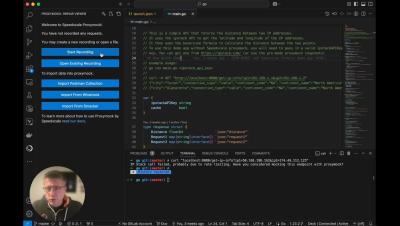
Intro to proxymock, a free traffic-based service mocking tool within VS Code.

Speedscale's proxymock is a free VS Code plugin that passively listens to transactions, so developers can replay past responses or inbound transactions like a time machine. Past transactions can serve as non-rate-limited service mocks, editable databases, or even regression/load/chaos tests. Building service mocks to serve as service virtualization/mocks can be time consuming and manual. Maintaining complex, shared environments for engineering incurs expensive cloud costs and aren't often accurate.

Ultimate Guide to Creating a JSON Mock API for Testing

Using a JSON mock allows you to avoid using fake data or simulating interactions, resulting in better final output and stronger data flows. Today, we’re going to dive into the process of creating a mock API using JSON data and tools like JSON-server. This guide will help you understand the basics of this process and get started quickly with your own mock API, allowing you to speed up development and testing without relying on a live backend.

Testing Vs Debugging: Prioritize Efficiently

In the world of software development, testing and debugging are two of the key components. These two key components are dedicated to different purposes. Before you prioritize between these two and know more about testing vs. debugging, you must have an in-depth knowledge of testing individually. Testing and debugging are essential for software development projects. This write-up will break down these two components, and you will receive insight into the comparisons and the factors related to them.

Coverage Requirements Discovery with WSO2 Accelerator for Healthcare

Coverage Requirements Discovery (CRD) is a process in the U.S. healthcare system that aims to improve the efficiency and accuracy of prior authorization workflows in healthcare. It involves a healthcare provider's system (like an Electronic Health Record or EMR) communicating with a payer's system to determine the specific requirements for a particular service or procedure before it is delivered to a patient.

Yaml Vs Yml: Developer'S Guide To Syntax And Ease Of Use

It sounds funny to know, but YAML stands for "YAML Ain’t Markup Language." Well, contrary to its unserious nomenclature, it’s considered a pretty widely used data serialization format known for good human readability and scalability. The theory becomes funnier when we realize that YML is simply a brief alternative to YAML, which has been done for some practical purposes.

How Your Team Can Achieve Sustainable Test Growth: Balancing Speed, Cost, and Quality in the AI Era

The promise of AI-driven development is undeniable – faster code, quicker releases, and unprecedented innovation. But here’s the catch: AI isn’t perfect, and the code it generates could be riddled with hidden flaws. In fact, within three years, over a third of all code will be AI-generated, and much of it may introduce more bugs into production than ever before.

Mastering Nyc: Enhance Javascript & Typescript Test Coverage

NYC, often referred to as Istanbul’s command-line interface (CLI), is a powerful code coverage tool designed specifically for JavaScript testing. It works seamlessly with testing frameworks like Mocha, Jest, and Ava, making it an invaluable resource for developers looking to measure and improve the coverage of their tests. NYC not only tracks how much of your code is covered by your existing test suite but also provides detailed reports that help identify untested parts of your codebase.

Introducing SmartBear Insight Hub: A New Era of Developer Observability

We’re excited to announce that BugSnag is now officially SmartBear Insight Hub. This evolution reflects the broadening of our capabilities beyond error monitoring to encompass full-stack observability with real-user monitoring, backend performance monitoring, and distributed tracing.

Build Better APIs Faster: How SmartBear API Hub Brings Everything Together

The development of SmartBear API Hub, powered by Swagger, represents a significant advancement in how teams manage, test, and optimize API workflows. Our journey to create a cohesive, unified suite – API Hub – required integrating standalone products into a single, robust ecosystem, establishing a seamless user experience that bridges workflows across each product.