

Systems | Development | Analytics | API | Testing

What Is a Control Plane for Enterprise AI? A Look Inside Klique

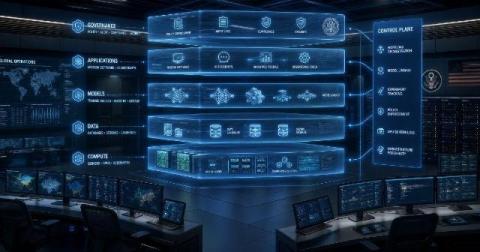
A control plane for enterprise AI is the layer between the people and agents using AI and the infrastructure that runs it, meaning your models, GPUs, clusters, and cloud accounts. It decides who can use what, sends each request to the right resource, and records what that request cost. Klique is the control plane for enterprise AI. Teams get self-service access to approved tools, models, and GPUs, and IT sets the policies, quotas, and budgets behind them.


How to Build a Self-Service AI Platform Without Losing Control of GPUs, Data, or Security

Most enterprise AI infrastructure conversations land on the same tension. Builders want self-service: instant access to GPUs, a stable endpoint for a model, a notebook, or a fine-tuning run that starts without a ticket. Platform teams want per-team quotas, identity-aware access, audit trails, tenant isolation, and cost attribution they can defend. Both sides are right, and most platforms make you choose between them because self-service and control get layered onto a base that was designed for neither.

From Experiment Tracking to AI Factory: What Changes When AI Becomes a Shared Enterprise Capability

The term “AI factory” is usually introduced as a hardware story: racks of accelerators, high-speed networking, and validated reference designs. That part is real, but it is not the part most organizations struggle with. The harder shift is operational. Moving from AI as a set of individual experiments to AI as a shared, governed capability that many teams depend on changes how compute is allocated, how environments are built, who owns the platform, and how the work is governed.

From Chatbot to Compound AI System: Infrastructure Patterns for Multi-Model, Tool-Using Applications

Two years ago, GenAI in production usually meant a single LLM serving a single endpoint. In 2026, it usually means much more. The applications shipping in front of users today are compound AI systems: orchestrated pipelines of retrievers, embedders, dialogue models, classifiers, code interpreters, SQL executors, and tools, with a single user request fanning out to several model calls across the stack.

Free Satellite Imagery for Machine Learning and Big Data Pipelines

The expansion of public satellite fleets has turned Earth observation into a true Big Data playground. What once required dedicated GIS servers can now be handled by cloud tools that pull fresh imagery continuously without breaking project budgets. This sudden abundance of open rasters completely changes how products get built. Having steady access to free satellite data for download and analysis allows engineering teams to test new ideas, train computer vision models, and scale geographic coverage fast, without paying a cent for raw image feeds.

The Impact of AI and Machine Learning on Real Estate Business

Artificial Intelligence (AI) and Machine Learning (ML) are changing the way the real estate industry operates. From property valuation and investment analysis to customer service and marketing, these technologies are helping businesses process information faster and make more informed decisions.

Why AI Sovereignty Is an Operational Problem

AI sovereignty has become one of those phrases that sounds precise until someone asks what it actually means. For one federal agency, sovereignty means keeping sensitive data inside accredited boundaries. For another, it means running open-weight models in a FedRAMP-authorized private cloud. In defense and intelligence settings, it may mean operating inside an air-gapped environment at IL5 or IL6.

Building a Custom ML Pipeline: The 2026 Reference Architecture, Open-Source Building Blocks, and Decision Framework

Enterprise AI is moving beyond experimentation. Today, the real challenge is not building machine learning models but operationalizing them at scale through reliable training, deployment, monitoring, governance, and continuous improvement. This shift is accelerating rapidly. Gartner reports that organizations with high AI maturity are more than twice as likely to keep AI initiatives operational for three years or more, underscoring the growing importance of robust MLOps practices.

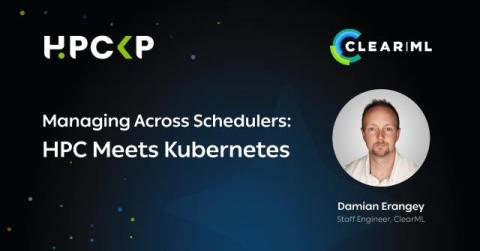
Managing Across Schedulers: HPC Meets Kubernetes

Almost every infrastructure team running modern AI is wrestling with the same question. The orchestrator their AI workloads want, Kubernetes, and the orchestrator their HPC environment was built on, Slurm, pull in different directions. This piece, drawn from the HPCKP 2026 session of the same name, looks at why that tension exists, what the workloads actually look like, how teams are bridging the two today, and where the pattern is heading.

Beyond Brittle Code: Scaling Enterprise QA with Machine Learning in Test Automation

As product delivery cadences shrink, traditional quality assurance approaches are reaching operational constraints. Traditional scripted test scripts, albeit a tried-and-true method in the past, can no longer keep up with the onslaught of dynamic code changes, changing microfrontends, and CI pipelines. In many cases, just changing a label or making a small modification to a layout may break whole integration suites and create huge backlogs.