Systems | Development | Analytics | API | Testing

The Month-End Close That Never Ends (Until Now)

It's 9 PM on Day 5 of the month-end close. Your controller is still at their desk, squinting at the intercompany reconciliation spreadsheet that refuses to balance. The German subsidiary's numbers came in late (again). The currency conversion formulas broke when someone accidentally sorted column B. And tomorrow morning, the CFO needs consolidated financials for the board meeting.

From Excel Hell to AI-Powered Finance: A CEO's Journey to Data-Driven Decision Making

"We were wasting too much time debating the accuracy of numbers as opposed to using that time to make decisions." That's how Satty Saha, Group CEO of CreditInfo-a credit bureau operating across 30+ countries-described the moment he realized his organization had a data problem. Not the kind of data problem you'd expect from a company whose business is data and analytics. An internal data problem.

Why Deterministic Queries and Stored Procedures Are the Future of AI Data Access

Executive Summary: As enterprises integrate AI and large language models (LLMs) into their data workflows, the need for predictable, secure, and auditable database interactions has never been greater. Deterministic queries—particularly those encapsulated in stored procedures—provide the guardrails necessary for both human analysts and AI systems to access sensitive data safely.

Collections: A New Way to Tackle Content Clutter with ThoughtSpot

Eliminate the chaos of content sprawl and bring structure to your analytics environment. In this feature deep-dive, we explore Collections, a powerful new way to organize, navigate, and share your ThoughtSpot assets using a smart, hierarchical folder system. In this video, you will learn how to: The Result? A radically cleaner user experience that empowers executives to find answers faster and allows admins to govern content with surgical precision.

Capturing User Logins for Business Intelligence Insights with ThoughtSpot

Bridge the gap between deploying analytics and driving actual adoption by capturing and analyzing real-world user login behavior. In this technical walkthrough, we explore how to utilize ThoughtSpot CS Tools to extract audit logs and activity data, giving admins and stakeholders clear visibility into platform engagement. In this video, you will learn how to: The Result? A data-driven approach to platform administration that replaces intuition with hard evidence of user adoption and engagement.

Building for Agentic AI

Our customers’ worlds are complex, and for good reason. It’s multi-cloud. It’s SaaS plus on-prem. It’s Snowflake, Databricks, AWS, Azure, Salesforce, and more. Underneath every one of those choices is the same constraint: data must be accessible, stay current, and stay controlled. The hard part is getting trusted data where it needs to be, when it needs to be there, with the controls to use it responsibly.

Making Data Work for AI

AI is not a pilot anymore. In 2026, it is the operating agenda. And if you’re leading a business or an IT project right now, you’re probably getting the same two questions. First: “When do we see real outcomes?” Second: “Can we trust what we’re getting?” Those are fair questions. They’re the right questions. Because the truth is, the model is rarely the problem. The hard part is everything around it. The data. The access. The silos. The controls.

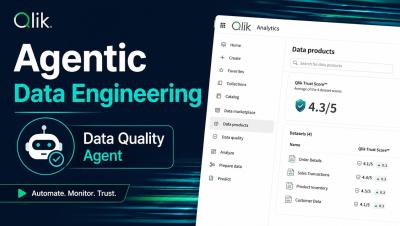
Qlik: Making Data Work for AI

AI is moving fast, but outcomes still depend on one thing: trusted data, in the right place, at the right time, with the right controls. In this short Qlik story video, you’ll see how we help teams accelerate AI with confidence, turning data into answers you can explain, and actions you can stand behind. From strengthening supply chain decisions, to building a campaign plan in seconds, to spotting changes as they happen, Qlik connects analytics, automation, and governed AI experiences, so AI becomes operational, not experimental.

Streaming Data Integration with Apache Kafka

Data streaming with events supports many different applications and use cases. Event-driven microservices use data streaming, allowing companies to build applications based on domain-driven designs. This approach allows teams to break applications into composable microservices that can be worked on independently, speeding development. These designs scale well and can process huge amounts of data efficiently.