Systems | Development | Analytics | API | Testing

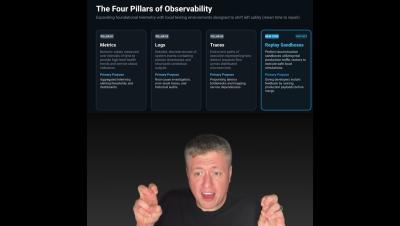
AI is Exposing Observability's Dirty Secret

The 3 pillars of observability are breaking. For years, dev teams relied on Logs, Metrics, and Traces to know when something went wrong. But now? AI agents are writing, deploying, and changing code in real-time. When an AI hallucination pushes a bug to production, standard monitoring sees nothing wrong.To survive the AI era, we need a 4th Pillar of Observability. Watch to find out what it is and why the old way of monitoring just became obsolete.

Kafka in a DMZ: Protecting AWS MSK with Kong Event Gateway

Running Apache Kafka on Amazon Managed Streaming for Apache Kafka (MSK) gives you a managed broker with no ZooKeeper to operate, automated patching, and multi-AZ replication handled by the service. What it doesn't give you is a safe, governed way to expose Kafka access beyond your VPC boundary. That problem looks simple on the surface. It isn't. And how you solve it has significant implications for security posture, operational complexity, and monthly cost.

How Agentic AI and Cloudera are Transforming Crisis Response

Can AI actually save lives? In this video, see how Cloudera and Mercy Corps have partnered to put people—not just technology—at the heart of humanitarian aid. Through a two-and-a-half-year collaboration, we’ve worked side-by-side with analysts to map real-world workflows and co-create AI solutions that solve their most pressing daily challenges.

Agentic AI Test Execution Inside Jira with Xray and Lynqa

AI is becoming part of every stage of the testing lifecycle. Teams are using it to analyze requirements, design test cases, generate automation scripts, and accelerate execution activities that previously required significant manual effort. Within Xray, AI already helps transform Jira requirements into actionable test cases with AI Test Case Generation.
Sponsored Post

Build WireMock mappings fast from real traffic

I'm a big fan of service mocking. I've been working in and around software for about 25 years, and one thing never changes: when you sit down to work on your code, you almost never have everything available. The database, the third-party API, the message queue, the service two teams over. Something's missing. So you've got to stub it out or mock it out and keep moving.

Decoding the Data Fabric: From Regulation to Runtime

Spend enough time in the data management world, and you’ll quickly encounter a flood of terminology: semantic layers, knowledge graphs, unified metadata, governance fabrics, data meshes, and, of course, agentic AI. Most organizations know these aspects matter, yet many still struggle to understand how they fit together. The problem with traditional data architecture is that it is often treated as purely technical.

Maintenance Testing: Types, Challenges & Tools (2026)

Last month, a two-line bug fix took down three unrelated features in a colleague’s app. The fix itself was correct — it patched a null check on a checkout API. Nobody re-ran the tests for the inventory service that depended on it, and by Monday, support tickets were stacking up. That gap is exactly what maintenance testing exists to close. Maintenance testing is the QA work you do after software ships — testing every bug fix, upgrade, patch, or migration to confirm nothing else broke.

How to Test AI Applications Manually: A Playbook for Hallucinations, Bias, and Non-Deterministic Outputs

You have tested hundreds of features. You know the drill. Open the test case, write the preconditions, list the steps, fill in the expected result, run it, compare. Pass or fail. Move on. Then someone hands you an AI feature. A chatbot. A "summarize this ticket" button. A search box that answers in full sentences instead of returning a list of links. You open your test case template, you get to the "expected result" field, and you stop.