Systems | Development | Analytics | API | Testing

How to Repair Corrupted or Broken Photos Online for Free

In today's digital world, capturing images has become a crucial task in our lives. Sometimes the pictures we take do not turn out right, and they appear corrupted or broken. If a picture is damaged, it will look strange, like it is all grey or the colours are wrong. Luckily, several photo repair methods are available to fix pictures that are damaged.

Free Satellite Imagery for Machine Learning and Big Data Pipelines

The expansion of public satellite fleets has turned Earth observation into a true Big Data playground. What once required dedicated GIS servers can now be handled by cloud tools that pull fresh imagery continuously without breaking project budgets. This sudden abundance of open rasters completely changes how products get built. Having steady access to free satellite data for download and analysis allows engineering teams to test new ideas, train computer vision models, and scale geographic coverage fast, without paying a cent for raw image feeds.

Reliability Engineering in the AI Era

Engineering leaders have been claiming to “shift quality left” for years but production remains stubbornly stuck out of reach of software engineers. The realm of production remains mysterious with tools no one has access to and UIs that wouldn’t make sense to engineers anyway. I’ve noticed a small but growing trend of large enterprises hiring Reliability Engineers instead of Site Reliability Engineers. Dropping one word looks cosmetic but I think it points to a much bigger change.

The Data Differentiator: Vanguard's Playbook for AI-Ready Data

Semantic layers and ontologies have moved from nice-to-have data modeling tools to the foundational engine required for enterprise AI. In this episode, Raman Tallamraju, Senior Director and Head of Enterprise Data Architecture and Engineering at Vanguard, breaks down how Vanguard is architecting its AI semantic layer to turn scattered institutional knowledge into reliable, agent-ready context. He shares why autonomous agents expose decades of hidden data debt, how to bridge domain-specific definitions like clients versus prospects, and how to balance building a unified semantic layer with a pragmatic, federated data operating model.

The AI Code Verification Crisis: Meet AURA, the platform built to solve it

AI didn't remove the release bottleneck, it moved it downstream. Code volume exploded, verification didn't. The old QA model isn't broken, it's outgrown: 80% of engineering teams have already traced a production incident to AI-generated code. AURA is Sauce Labs' answer, the only full-lifecycle release assurance platform built to close the gap. It continuously verifies every release against business intent, authoring, running, and regenerating tests in an autonomous learning loop, with humans in control.

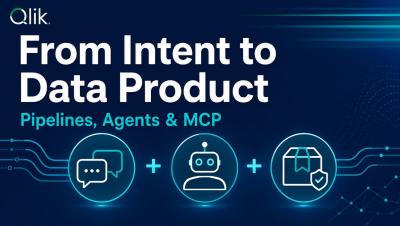
From Intent to Data Product: Pipelines, Agents & MCP

The challenge for most data teams isn’t a lack of ideas—it’s the time it takes to turn those ideas into something usable. In this session, Steffen Bischoff, Chief Architect Data at Qlik, follows a single dataset from a core system through its entire journey to becoming a governed data product. You’ll see pipelines created by describing intent instead of writing code, versioned in Git, then curated, quality-checked, and documented with the help of specialized agents. From there, the data product is made available to the AI tool of your choice through the Qlik MCP Server.

Vibe Coding to Production: Building AI Apps That Actually Scale

Now that AI coding tools have put development capabilities into more hands, prototypes are becoming business-critical applications almost overnight. Shanea Leven sees an opportunity for a new generation of builders, provided the infrastructure around their applications keeps pace. Shanea explains how organizations can give developers and new technical employees room to build while maintaining the standards required for enterprise software..

How Does Tier 2 SOC Automation Work?

Tier 2 SOC work picks up evidence gathering across consoles, containment decisions, sandbox detonation and verdicting, sweeping new indicators through historical data, and the case documentation and handoff that follow. Tier 1 work is linear enough to enumerate, so a playbook can list the steps. Tier 2 investigations branch, since each answer changes the next question, and no engineer can pre-write every path and that is why SOAR does not do well in Tier 2 even in teams where it works well at tier 1.