Systems | Development | Analytics | API | Testing

The latest News and Information on Software Testing and related technologies.

What Is MTTR? Definition, Formula & Benchmarks (2026)

MTTR is the metric that tells you how long your users wait after something breaks. According to Splunk and Cisco’s Hidden Costs of Downtime 2026 report, unplanned downtime now costs organisations an average of $15,000 per minute. Across the Global 2000 companies, the aggregate annual cost has surged to $600 billion, a 50% increase in just two years. Engineering teams shipping to production multiple times a day face a simple reality: incidents aren’t a matter of if.
CDSS EHR Integration Best Practices: A Technical Guide for Engineering Teams

Clinical AI projects usually fail during integration, not development. They work well in controlled environments, but production workflows expose problems. CDS Hooks and FHIR payloads can be inconsistent and incomplete. Engineering teams face a challenge: embedding clinical decision support into existing EHR workflows without disrupting care. The problem is not just about APIs. Teams must manage many things, including CDS Hooks, authentication, and latency constraints.

Neobank vs. Challenger Bank vs. Digital Bank: What You're Actually Building

The global financial landscape has shifted from digital-first to digital-only at a relentless pace. As we navigate 2026, the stakes for fintech founders and engineering leaders have never been higher. According to recent data from Fortune Business Insights, the global neobanking market is currently valued at approximately $310.15 billion, with a projected surge to a staggering $7.6 trillion by 2034.

The best tools don't force teams to change how they work

They fit into the workflows, processes, and environments teams already have. As Chris Armstrong, Manager of Developer Relations at SmartBear, explains, every organization is on a different stage of its journey. Some are exploring AI. Others are scaling it. Many are managing a mix of legacy systems, modern platforms, and everything in between. What teams need isn't another platform that demands a complete overhaul. They need solutions that respect their context while helping them move forward with confidence.

Generative AI for QA: How SDET Workflows and Skills Are Changing

Generative AI for QA is the use of large language models to accelerate the creation and analysis of testing artifacts — drafting test cases, summarizing requirements, and generating synthetic test data. AI agents extend that capability into multi-step autonomous workflows that plan, delegate, and execute testing tasks across an entire delivery pipeline. For SDETs, the shift is not about learning to prompt more cleverly.

Human in the Loop Testing: Where AI Ends and QA Judgment Begins

The question isn't whether to use AI in QA. It's knowing exactly where to keep a human in control. The core risk: Over 75% of multi-agent failures are silent semantic errors that pass automated checks but violate business logic — detectable only by human inspection (Cemri, Pan et al., NeurIPS 2025). The division of labor: AI owns repetitive generation and execution; humans own risk analysis, requirement interpretation, exploratory investigation, and final sign-off. The operational discipline.

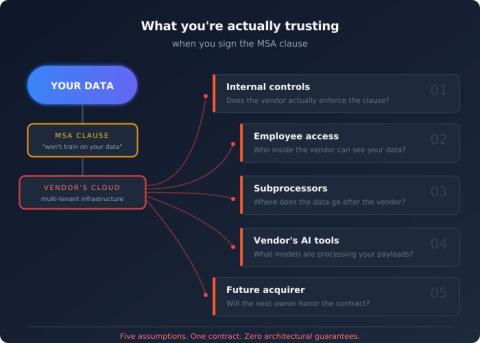
We won't train on your data is not a security architecture

Every enterprise contract I’ve signed in the last two years has the same clause. “Vendor will not use Customer Data to train machine learning models.” Sometimes it’s a paragraph. Sometimes it’s a whole section. The language varies but the intent is identical: don’t feed our production data into your AI. I get it. I sign the same clause as a vendor. But here’s what’s been bothering me: that clause is a promise, not an architecture.

Practical applications for NeoLoad MCP: 3 use cases

As AI-aided software development lifecycles pick up speed, performance teams are left with the familiar challenge of too much work, too few specialists, and results that take too long to analyze. Over the past year, Tricentis NeoLoad has shipped capabilities designed to address each of these problems directly. What started with Augmented Analysis accelerating root cause identification grew into a fully connected Model Context Protocol (MCP) architecture.