Systems | Development | Analytics | API | Testing

Power Your Lead Scoring with ML for Near Real-Time Predictions

Every organization wants to identify the right sales leads at the right time to optimize conversions. Lead scoring is a popular method for ranking prospects through an assessment of perceived value and sales-readiness. Scores are used to determine the order in which high-value leads are contacted, thus ensuring the best use of a salesperson’s time. Of course, lead scoring is only as good as the information supplied.

Keboola + ThoughtSpot = Automated insights in minutes

Keboola and ThoughtSpot partnered up to offer click-and-launch insights machines. With the original integration, you can already cut the time-to-insight. Keboola helps you get clean data and ThoughtSpot helps you turn it into insights. What’s new? The new solution builds out-of-the-box and ready-to-use data pipelines (Keboola Templates) and live self-serve analytic dashboards (ThoughtSpot SpotApps) from the ground up. You just need to click-and-launch your analytic use case.

How to Distribute Machine Learning Workloads with Dask

Tell us if this sounds familiar. You’ve found an awesome data set that you think will allow you to train a machine learning (ML) model that will accomplish the project goals; the only problem is the data is too big to fit in the compute environment that you’re using. In the day and age of “big data,” most might think this issue is trivial, but like anything in the world of data science things are hardly ever as straightforward as they seem.

How to Do Data Labeling, Versioning, and Management for ML

It has been months ago when Toloka and ClearML met together to create this joint project. Our goal was to showcase to other ML practitioners how to first gather data and then version and manage data before it is fed to an ML model. We believe that following those best practices will help others build better and more robust AI solutions. If you are curious, have a look at the project we have created together.

7 Best Change Data Capture (CDC) Tools of 2022

As your data volumes grow, your operations slow down. Data ingestion - extraction of all underlying datasets, transformation, and loading in a storage destination (such as a PostgreSQL or MySQL database) - becomes sluggish, impacting processes down the line. Affecting your data analytics and time to insights. Change Data Capture (CDC) makes data available faster, more efficiently, and without sacrificing data accuracy. In this blog we are going to overview the 7 best change data capture tools of 2022.

A Guide to Principal Component Analysis (PCA) for Machine Learning

Principal Component Analysis (PCA) is one of the most commonly used unsupervised machine learning algorithms across a variety of applications: exploratory data analysis, dimensionality reduction, information compression, data de-noising, and plenty more. In this blog, we will go step-by-step and cover: Before we delve into its inner workings, let’s first get a better understanding of PCA. Imagine we have a 2-dimensional dataset.

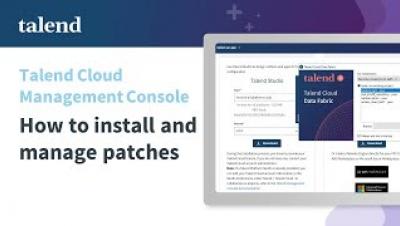
[DEMO] How to manage Talend Studio updates from Talend Management Console?

Talend Cloud provides powerful graphical tools and 900+ connectors and components to connect databases, big data sources, on-premises, and cloud applications. Design cloud-to-cloud and hybrid integration workflows in Talend Studio and publish them to a fully managed cloud platform. If you are using Talend Cloud Management Console with Talend Studio, depending on your license, you can create executable tasks for Jobs, Data Services, and Routes published from Talend Studio and run them directly in the cloud or on Remote Engines, ensuring the security of your data. =

What You Should Know About Corporate Loyalty and IT

This is a guest post with exclusive content by Bill Inmon. Bill “is an American computer scientist recognized by many as the father of the data warehouse. Inmon wrote the first book, held the first conference, wrote the first column in a magazine, and was the first to offer classes in data warehousing.” -Wikipedia. The five critical considerations for corporate loyalty.