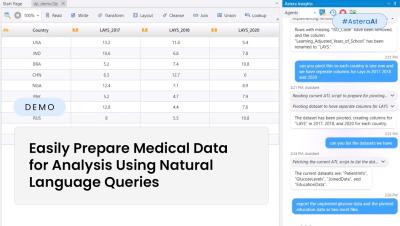
Automate Medical Report Processing with Astera in 4 Simple Steps

Processing medical reports from various labs, clinics, and hospitals can be smooth and efficient with Astera. No matter the format or source, Astera simplifies every step of the process. Automatically ingest reports, extract key data fields like patient details, test results, and diagnoses with precision and deliver clean, ready-to-use data straight to your EMR systems, databases, or Excel. With Astera, your team can save time, reduce manual effort, and focus on delivering faster, more accurate patient care.

A Comprehensive Guide to Integrating Product Analytics With Other Data Sources and Systems

In today's data-driven world, product analytics is crucial in understanding user behavior, improving product features, and driving business growth. However, product analytics alone may not provide a complete picture of user interactions and business performance. Integrating product analytics with other data sources and systems is essential to gain deeper insights and make more informed decisions.

Predictive Analytics: How Generative AI and Data Streaming Work Together to Forecast the Future

Predictive analytics is changing how businesses make decisions. Companies can use data, machine learning, and statistical modeling to forecast outcomes with better accuracy. So, how can predictive analytics techniques transform your business? Predictive analytics uses historical data to predict future events. It involves understanding the relationships within your data to predict what's next, impacting industries from retail and healthcare to finance and manufacturing.

The Power of Predictive Analytics in Healthcare: Using Generative AI and Confluent

Implementing predictive analytics in healthcare empowers healthcare providers to take a data-driven approach to anticipating future events and making informed decisions. It helps healthcare professionals forecast the progression of diseases, plan and optimize resource allocation, and ultimately shift from reactive to proactive care. This approach improves patient health outcomes and overall efficiency.

4 data streaming trends for 2025

Buckle up, we’re past the AI hype. Now, it’s about making intelligent systems that act on our behalf. In 2025, AI isn’t just a tool– it’s becoming our core way of operating, powered by real-time data. How we stream, manage and monetize that data will define the next generation of business. Here, we zoom into four examples of what autonomous real-time intelligence could look like in the coming year.

Snowflake CDC: A 101 Guide from a Data Scientist

Snowflake is one of the top cloud data warehouses. Regardless of the many documentations available, I have personally faced issues while carrying out Snowflake CDC (Change data capture). Therefore, I thought sharing everything a data practitioner should know about this before you start would be helpful. Let’s jump right into it!

Efficient Data Integration with Improved Error Logs Using OpenAI Models

In today’s data-driven world, Large-scale error log management is essential for maintaining system functionality. It can be quite difficult to pinpoint the underlying causes of problems and come up with workable solutions when you're working with hundreds of thousands of logs, each of which contains a substantial amount of data. Thankfully, automating this process using fine-tuned AI models—like those from OpenAI—makes it more productive and efficient.

Best Practices for Building Robust Data Warehouses

In the ever-expanding world of data-driven decision-making, data warehouses serve as the backbone for actionable insights. From seamless ETL (extract, transform, load)processes to efficient query optimization, building and managing a data warehouse requires thoughtful planning and execution. Based on my extensive experience in the ETL field, here are the best practices that mid-market companies should adopt for effective data warehousing.