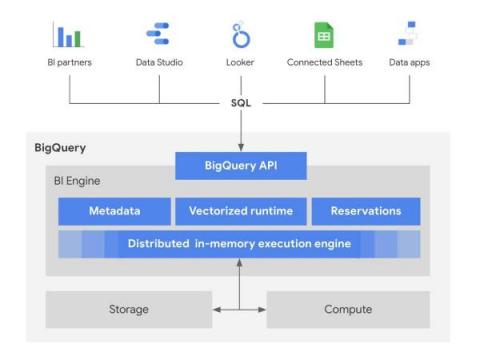
At the DataOps Unleashed 2022 conference, Google Cloud’s Head of Product Management for Open Source Data Analytics Abhishek Kashyap discussed how businesses are using Google Cloud to build secure and scalable data platforms. This article summarizes key takeaways from his presentation, Building a Scalable Data Platform with Google Cloud. Data is the fuel that drives informed decision-making and digital transformation.
Today’s organizations want stronger alignment between the cost of SaaS solutions and the value derived from these products. As a result, many software companies are looking at adopting consumption-based pricing models as an alternative to subscription models. With consumption-based models, customers only pay for what they use, and usage is tied directly to the value customers derive. Of course, consumption means software companies don’t experience revenue until customers use the solution.
Please join us on March 24 for Future of Data meetup where we do a deep dive into Iceberg with CDP
We are excited to announce the integration of Tecton’s enterprise feature store and Feast, the popular open source feature store, with Snowflake. The integration, available in preview to all Snowflake customers on AWS, will enable data teams to securely and reliably store, process, and manage the complete lifecycle of machine learning (ML) features for production in Snowflake. Tecton allows data teams to define features as code using Python and SQL.
It’s one thing to talk about orchestrating and automating your organization’s data operations. It is quite another to gain the confidence that comes with having a unified view of your data. This just-in-time view of the truth simultaneously reduces data privacy risk and enables your business to pursue data-driven goals.
The Covid-19 pandemic has resulted in an unprecedented global economic landscape that is dominated by loose monetary policies, low borrowing costs and influx of capital in the equity markets. Against that backdrop, Mergers and Acquisitions (M&A) activity has surged since 2021 as companies are trying to take advantage of the current environment and adapt to the new business realities shaped by the global pandemic.
The first step in most analytical workloads is to ingest the data that you need for your analysis into your data warehouse. For geospatial analysis involving point, line, or polygon data, ingesting data can be complex because geospatial data comes in myriad data formats. Two of the most popular geospatial formats are GeoJSON and GeoJSON-NL (newline-delimited geoJSON).