Systems | Development | Analytics | API | Testing

Dependency Mocking and Service Virtualization: Make Every CI Test Deterministic

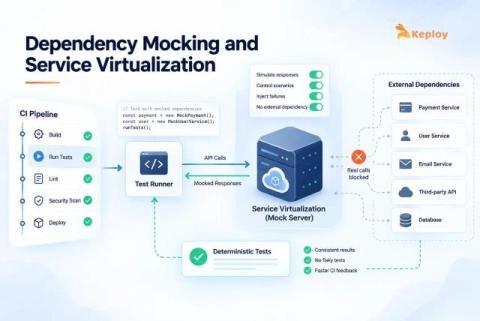
Dependency mocking replaces real external dependencies (APIs, databases, queues) with controlled substitutes during testing. Service virtualization extends this to enterprise scale, adding stateful simulation and protocol support beyond HTTP. Keploy implements a traffic-capture approach: it records real dependency interactions at the kernel level using eBPF and replays them in CI, making integration tests deterministic without manual stub writing.


Flexible Crypto Invoicing: How Configurable Payment Windows Support Complex Business Scenarios

Cryptocurrency transactions are widely recognized for their settlement speed, with transfers often processing and finalizing in just a few minutes. While rapid execution is a core advantage of blockchain technology, digital payment workflows must accommodate more than just instant execution. Many corporate setups-such as subscription billing, reservation management, account funding, and enterprise B2B contracts-require structural flexibility that standard automated systems cannot support due to internal approval delays or operational buffer times.

7 Best Unstructured Data Tools for Enterprise AI (2026 List)

Enterprise AI depends on data that was never designed for AI. Most business knowledge is not sitting neatly in rows and columns. It is spread across documents, emails, chats, tickets, logs, telemetry streams, PDFs, customer conversations, search indexes, knowledge bases, product content, operational systems, and digital experience platforms.

Best 7 Virtual CDN (vCDN) Providers in 2026

Organizations no longer deliver content through a single website hosted in one region. Modern digital services power everything from SaaS applications and ecommerce stores to media platforms, gaming environments, APIs, software downloads, and AI-driven applications. Every interaction depends on fast, reliable delivery regardless of where users are located or how network conditions change throughout the day.

Real-Time Fraud Detection Pipelines: How Fintechs Use ETL for Streaming Data

Your fraud detection system analyzes yesterday's transactions while criminals steal millions today. Financial institutions lose an estimated $33 billion annually to card fraud alone, much of it preventable with real-time detection capabilities. Traditional batch processing that analyzes data hours or days after transactions occur simply cannot keep pace with sophisticated fraud schemes exploiting the settlement window gap.

How to Consolidate Multi-Bank Transaction Data With Low-Code ETL

Every finance team managing multiple banking relationships knows the pain: downloading statements from six different portals, copying transaction data into spreadsheets, and spending hours reconciling figures that should match but don't always align. With businesses losing significant productivity due to manual data handling and delayed system synchronization, multi-bank data consolidation has become a critical operational challenge.

How to Build a Scalable Enterprise Testing Strategy for Engineering Teams

Enterprise software today isn't just complex, it's mission-critical. A single production issue can disrupt operations, impact revenue, and erode customer trust overnight. Yet despite years of investment in enterprise test automation and growing QA headcount, many organizations still ship broken software and miss release windows. The uncomfortable truth? Enterprise software doesn't fail because teams aren't testing enough.

Automating the Exception: How a Second LLM Judge Drives Straight-Through Processing

Document-centric workflows have been difficult to automate and required human intervention. Attempts to automate document handling often failed or did not scale, because legacy intelligent document processing (IDP) systems were fragile. They often required manually retraining models on dozens of documents just to identify specific fields—only to repeat the process whenever a format changes. The result was a costly cycle of maintenance and manual data entry.

Solving Agent Sprawl: Why AI Agents Need an Operational Context Layer

Since its inception, agentic AI has felt like a distant aspiration. Today, agents are here, and enterprise adoption is accelerating. Gartner predicts that by 2028, the average global Fortune 500 enterprise will have more than 150,000 AI agents in use, up from fewer than 15 in 2025. Agents arrive with incredible, broad intelligence, but lack the knowledge of your operating model: your customers, policies, approvals, exceptions, business rules, systems, and operational history.

Shadow AI Detection: The Enterprise Governance Guide

Shadow AI detection is the practice of finding and governing unsanctioned AI tools, models, and API integrations that employees deploy without security approval. It has become urgent because these tools route live enterprise data to external models in real time, and traditional security stacks cannot see them. The 2026 Cordyceps disclosure, which exposed identical AI-generated vulnerabilities across 300+ GitHub repositories, showed how fast ungoverned AI can turn into a supply-chain crisis.