Systems | Development | Analytics | API | Testing

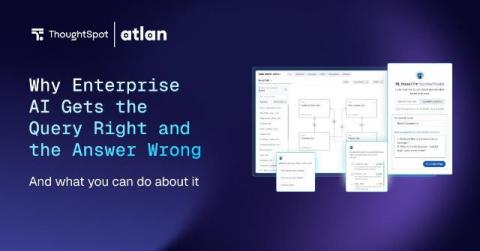
Why Enterprise AI Can Get the Query Right and the Answer Wrong

Most teams deploying AI agents on their data are watching the wrong things. They check whether the query ran and whether the number looks plausible. When both checks pass, the agent gets credit for a correct answer, and the output flows into dashboards, decisions, and the next agent in the chain. There's a gap between those two checks and actual correctness, and it's where the expensive mistakes live. Getting to a correct answer requires more than a formally valid calculation.

Why traditional QA metrics fall short as AI enters the pipeline

Take this scenario: Your team ships a release with 91% code coverage. Every test in the suite passes. The pipeline is green, and leadership signs off. But two days later, a critical defect surfaces in production. Upon investigation, you find that the changed code was never actually tested, and the tests that were run covered different paths entirely. That 91% was real, but it was just measuring the wrong thing. And as AI tools generate more of the code inside those pipelines, the gap widens.

AI Connection Pooling Best Practices | DreamFactory

Key takeaways: For AI workloads, pooling must handle long connection hold times and heavy traffic. DreamFactory is a secure, self-hosted enterprise data access platform that provides governed API access to any data source, connecting enterprise applications and on-prem LLMs with role-based access and identity passthrough. Combined with tools like PgBouncer, these solutions free connections faster and improve scalability. Simple tweaks, such as segmenting pools and setting timeouts, can boost efficiency.

RAG Pipeline Testing: How to Validate Retrieval, Context Use & Answer Accuracy

Large Language Models (LLMs) are impressive, but they are not without significant flaws. Their biggest hurdles are "knowledge cut-offs" where they cannot access information created after their training, and a tendency to "hallucinate" or confidently state false information. These models often struggle with the specific or real-time data that modern businesses rely on daily.

AI-Ready APIs for Legacy Systems

80% of enterprise apps still use decades-old systems, but accessing their data for AI is tough. The challenge? Security risks, outdated interfaces, and slow performance. Here's the solution: API abstraction. This method creates a secure, no-code layer between AI and legacy systems. It keeps your old code intact while enabling AI to access data safely and efficiently.

Dynamic Data Masking for AI Access | DreamFactory

Dynamic Data Masking (DDM) is a real-time solution to protect sensitive information when AI systems access enterprise data. It intercepts database queries and applies masking rules based on user roles, ensuring sensitive fields like Social Security numbers or credit card details are hidden without altering the original data. This approach prevents accidental exposure, ensures compliance with regulations like HIPAA and GDPR, and safeguards against attacks like prompt injection (successful 91% of the time).