Systems | Development | Analytics | API | Testing

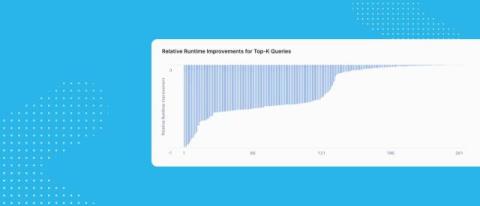
Continued Investments in Price Performance and Faster Top-K Queries

The Snowflake AI Data Cloud is an end-to-end platform that supports all types of data, compute, use cases and personas across an entire organization. By delivering a single, unified platform for all users, it is no surprise that organizations continue to expand their use cases on Snowflake. And therefore, it is extremely important for us to reaffirm our commitment to price-performant queries for our customers on a consistent basis.

Automation and Orchestration Technologies Are Converging: Here's 4 Reasons Why

Automation has unleashed unprecedented productivity and profits for organizations. By automating formerly manual tasks, businesses see efficiency gains, reduced human error, cost savings, and improved innovation. Automation frees employees for creative work and work that requires human intervention. To facilitate this, many organizations have stitched together a wide range of automation tools. This includes robotic process automation (RPA), generative AI, predictive AI, and business process management.

Monetizing a Gen-AI-Based ChatBot API by Metering Token Usage

For many Gen AI-based applications, usage-based billing is crucial. It is especially important if you are using third-party models that charge you for tokens used. You want to ensure that your cost of tokens used is covered by your customers, in addition to charging for your own value add. In this tutorial, we will build a quick Chat Bot API using OpenAI’s ChatGPT, and then use Moesif and Stripe to meter the number of tokens used and report the usage to Stripe to be charged.

An Overview of Cloudera's AI Survey: The State of Enterprise AI and Modern Data Architecture

Enterprise IT leaders across industries are tasked with preparing their organizations for the technologies of the future – which is no simple task. With the use of AI exploding, Cloudera, in partnership with Researchscape, surveyed 600 IT leaders who work at companies with over 1,000 employees in the U.S., EMEA and APAC regions.

The Role of Security Testing for LLMs Implementations in Enterprises

Businesses are seeking ways to collect all the data from their digital sources and draw out patterns that can reinterpret human participation with automation. A vanguard in this attempt is the emergence of large language models (LLMs) powered by artificial intelligence (AI).

Accelerating Academic Medical Research with an AI-Driven Data Strategy

Academic medical centers (AMCs) are a critical keystone of healthcare systems worldwide. They serve as major hubs of medical research, pioneering new treatments that advance and set the standard of care throughout medicine. They also educate and train the next generation of healthcare professionals, ensuring that the medical field continues to advance. In the U.S. alone, there are more than 230 active AMCs, and a significant number are part of a health system.

Top 7 Must-Try AI API Tools for Developers

Upon close inspection of the growing adoption of artificial intelligence across different industries, it becomes apparent that a lot it rests on the shoulders of API-powered systems. A survey by McKinsey found that 56% of respondents reported AI adoption in at least one function within their organizations, with significant increase in the use of AI APIs for tasks like natural language processing and computer vision.

Flink AI: Real-Time ML and GenAI Enrichment of Streaming Data with Flink SQL on Confluent Cloud

Modern data platforms enable enterprises to extract valuable business insights from data, sourced from various origins. Data engineers, data scientists, and other data practitioners utilize both data streaming and batch processing frameworks as a means to provide these insights. While batch processes work on historical data, stream processing extracts insights in real time, enabling businesses to react faster with respect to changing events.

Benefits and Applications of Open Source AI

The open-source philosophy and principles have always been about the democratization of knowledge—giving everyone the opportunity to access, learn, modify, and share software freely. As we see AI technologies seemingly taking over our day-to-day lives, we need those benefits in AI as well. Open-source AI inherits the open-source principles. It fosters transparency and collaboration, allowing us to build robust and secure AI systems.