Systems | Development | Analytics | API | Testing

Presenting The Bugfender MCP: Use Your AI Agent to Find and Fix Bugs

You asked for it. We built it. Our new MCP server means you can debug directly inside your AI coding tool using real app data from Bugfender. You can use it to: It works with Cursor, Claude Code, Codex and Gemini CLI. This article will show you how to install the Bugfender MCP server, which tools your agent can access, and how the companion skills help you fix bugs faster.

How to Talk to Your CFO About AI Gateway Metrics Without Losing Them in the First Slide

Your AI infrastructure is producing financial signals your CFO has never seen. Token consumption is a direct cost line item. Cache hit rate is a margin improvement. Model routing decisions are cost arbitrage events. These things are happening right now, in the gateway layer, with no route to the CFO, which means no route to the boardroom. As the AI connectivity platform owner, you're the person who can build that route.

Your AI Agent Knows What. It Doesn't Know Why.

There's a reason we don't find our keys by scanning every room like a security camera. We replay the tape. We remember the groceries, the front door, the distraction. We reconstruct the *why* to find the *where*. Our brains are commit logs, not snapshots. Most agentic AI systems today work more like the camera — a static frame of the world at a given moment. They store state. They retrieve context. They produce an answer.

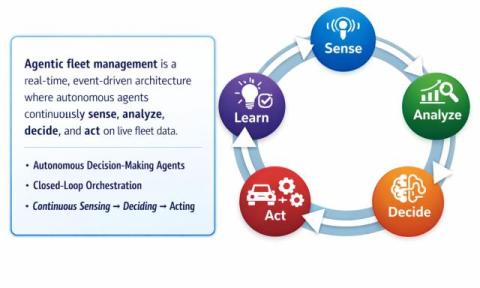
Agentic Fleet Management Architecture for Real-Time Operations

Agentic fleet management is a real-time, event-driven architecture where distributed AI agents continuously process streaming data to make autonomous operational decisions and execute them through closed-loop feedback systems. At its core, agentic systems enable: Unlike traditional systems that react to events after the fact, agentic architectures operate as adaptive, self-optimizing systems.

Anatomy of the AI Software Factory: The Context Layer

This is Part 2 of the AI Software Factory series. In Part 1, we established that the Agile methodology is buckling under the weight of “elastic code.” When AI agents can generate functionality in seconds, two-week sprints and manual task management become organizational bottlenecks. We introduced the concept of the AI Software Factory: a shift from managing human tasks to managing business intent through a “Funnel of Increasing Trust.” But a factory requires infrastructure.

The API testing gap: How AI-accelerated development challenges software quality

While AI accelerates development velocity by a factor of ten, a critical consequence remains: testing hasn’t kept pace. According to SmartBear research, 70% of software professionals report that their application quality has already degraded due to AI-accelerated development. Even more concerning, 60% have experienced quality issues in the past year as development velocity outstrips testing capacity.

Oracle MCP Server: Connect Oracle Database to AI Agents Safely

Last updated: May 2026 An Oracle MCP server is a service that exposes Oracle Database data as tools an AI agent can call through the Model Context Protocol (MCP). Rather than handing an LLM direct credentials to a database holding ERP, financial, or healthcare records, you put an MCP server between the agent and Oracle.

Snowflake MCP Server: Conversational Analytics with AI Agents

Last updated: May 2026 A Snowflake MCP server is a service that exposes Snowflake warehouses as tools an AI agent can call through the Model Context Protocol (MCP). It sits between AI clients like Claude or ChatGPT and your Snowflake data, translating discoverable tool calls into governed SQL — with row access policies, dynamic data masking, query budgets, and audit logging applied automatically.