Systems | Development | Analytics | API | Testing

Add resumable streaming and reliable tool calling to your OpenAI agent

If you build an agent against OpenAI's Responses API then the simplest way to get output to the user is streaming over HTTP/SSE. If the user refreshes the page, loses connection, switches devices, or needs to approve a tool call, then there's nothing in the API to help you. AI Transport is Ably's session layer for agent-to-user conversations. An agent built on it gets resumable streams, multi-device sessions, and approval gates that wait for a human user, without deploying additional infrastructure.

How AI Is Rebuilding the Insurance Claims Automation Lifecycle: The 2026 Guide

AI is restructuring how insurers run the claims lifecycle end to end from first notice of loss through payment and closure. This guide breaks down where AI insurance claims automation is delivering measurable results in 2026, the reference architecture behind it, and what insurers should prioritize first. Insurance claims automation 2026 connects AI, workflow orchestration, and core systems across the claims lifecycle the specific discipline behind Zymr’s own claims processing automation practice.

Top 7 Network Protocols Every Tester Must Know in 2026

Performance engineers who tailor their analysis to the specific behaviors and metrics of each network protocol will uncover issues that generic approaches miss. With protocols like QUIC and HTTP/3 seeing rapid adoption, keeping testing methods current is essential for credible results.

Ep 88 | AI Adoption vs. Adaptation: What Problem Are You Solving?

Paul McDonough-Smith estimates that many business leaders would struggle to define their organization’s problem clearly in fewer than 25 words. With AI, that lack of clarity can quickly turn into fragmented solutions and misplaced expectations. In this episode of The AI Forecast, Paul Muller sits down with Paul McDonough-Smith, a Visiting Senior Lecturer at MIT Sloan School of Management and a Senior Advisor to NASA's Goddard Space Flight Center, to explore how organizations can approach AI with greater clarity and purpose.

How to Build a Fee Transparency Compliance System for Multifamily Listings (While the Rules Are Still Settling)

A leasing team lowers the admin fee on a two-bedroom unit inside the PMS on Monday. By Friday, the property’s own site still shows the old figure, two syndication partners show a third number, and the Google Business Profile lists no mandatory fees at all. Every one of those surfaces is an advertisement. Under a growing set of state all-in-pricing laws, each one is supposed to display the same total monthly price. The regulation itself is readable in an afternoon.

What IT Teams Should Know Before Deploying Unified Communications

What can cause a unified communications rollout to go off track even when the initial project plan looks straightforward? Deploying unified communications may sound simple in a kickoff meeting, but in practice, it can be one of the more deceptively complex infrastructure projects an IT team can take on because it affects nearly every department at once. Network capacity, licensing, integrations, security, user adoption, and compliance requirements can all create problems if they aren't addressed early.

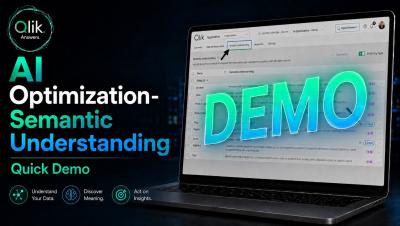
AI Optimization - Semantic Understanding - Quick Demo

AI Optimization is a workspace for managing how Qlik Answers understands an application. It brings semantic management into one experience, where you can review AI-generated semantic understanding and make corrections before they reach an answer. The result is a visible, correctable layer where there used to be none. AI Optimization is the central place to manage how Qlik Answers interprets your application. Semantic Understanding, inside it, shows and lets you edit this interpretation of each field and master item.

Where agentic AI is most valuable in performance testing

Quick summary: Performance teams can generate tests in minutes, but the analysis still takes hours. Agentic Performance Testing in NeoLoad uses domain-specialized AI agents to deliver a finished analysis from a single request, so engineers can start with the conclusions, rather than the raw data. Performance testing answers a critical question in the quality engineering lifecycle: will this hold up when real people use it, under real conditions, at real volume?

What actually makes you trust the software you ship?

What actually makes you trust the software you ship? Proof. As AI changes how software gets built, teams need more than faster delivery in a crowded market where new tools and solutions are constantly emerging. Trust has to be earned. They need application integrity: confidence that what they're shipping works as intended.