Systems | Development | Analytics | API | Testing

Stateful vs. Stateless Web App Design | DreamFactory

Last updated: May 2026 Stateful applications remember information about previous client interactions. Stateless applications treat every request as independent — no memory between calls. The choice between these two designs shapes how an application scales, how it handles failures, and increasingly how AI agents consume it.

SmartBear at Atlassian Team '26: A Recap of What's New with AI and Rovo

What did Atlassian Team ’26 reveal about the future of software quality and AI-powered delivery? In this recap from the event floor inside the Anaheim Convention Center, SmartBear shares key themes from the event, including Atlassian Rovo, the Teamwork Graph, AI-driven workflows, and how QA teams are adapting to faster, AI-assisted software delivery inside Jira. See quick highlights from the event floor, SmartBear’s latest Zephyr innovations, and how conversational AI and quality intelligence are becoming part of the modern software delivery workflow.

Tokens Per Watt Is the Real Limit on AI Revenue

Most AI revenue will flow through tokens — and the two bottlenecks are tokens per watt (energy cost) and tokens per second (throughput). Tokens per watt determines how much output you can generate from a fixed energy supply — already constrained and getting tighter. Tokens per second sets the ceiling on how fast that revenue can flow. Kong's AI Gateway optimizes both at the connectivity layer: semantic caching and semantic routing increase token output without adding watts or latency.#Shorts.

Instant Java Client SDK, no spec required!

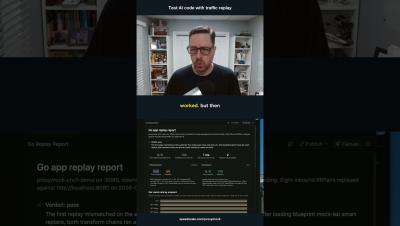
Learn how to generate a client SDK for a production service when you have no documentation, no OpenAPI spec, and no remaining team knowledge of the original Ruby code. This demo shows you how to capture real production data from a running app and transform it into a functional Java client library in minutes. Visit proxymock.io OR speedscale.com to learn more.

Are Microservices Dying?

LLMs are absorbing the business logic of microservices for agentic use cases — but both patterns will coexist in enterprise infrastructure for a long time. Cloud-native infrastructure (microservices + APIs) keeps powering web and mobile experiences. The agentic layer — LLMs, MCP tool calls, and context traffic — runs in parallel, activating the same APIs and CRUD operations underneath. Kong manages both swim lanes: the API traffic between clients and microservices, and the context traffic flowing between agents and LLMs.#Shorts.

CLI vs MCP: One Gives Speed, the Other Governance

CLI offers speed and developer freedom for API access; MCP provides centralized security, governance, and observability at enterprise scale. With CLI, credentials live on the developer's local machine and audit trails are shell-only — fast, but ungoverned. MCP adds authentication, centralized policy enforcement, and observability across all API calls, at the cost of some speed and higher token consumption. Kong's MCP Gateway is built for teams that need the governance trade-off without giving up too much velocity.#Shorts.

Anthropic Acquires Stainless. What's It Mean for AI Connectivity?

Every few months, a frontier AI lab makes a move that says the quiet part out loud: agents are only as useful as the systems they can reach. The latest example is Anthropic's acquisition of Stainless, the company behind the tooling that turns API specs into SDKs and MCP servers. Anthropic's own framing is direct. Agents need to connect to data and tools, and the path from an API to an agent-ready interface needs to get shorter. We agree. We've been making a version of this argument for two years.

How Headless Software Powers the Machine Internet

Software is going headless: the internet is shifting from GUIs built for humans to APIs, MCP servers, and CLIs built for machines and agents. Machines will consume the internet at a scale 1,000x greater than humans — more agents will exist than people, and programmatic access moves far more data than any click ever could. This transition requires API and AI infrastructure capable of moving terabytes at a scale never built before. Kong provides the connectivity layer for this machine internet — the infrastructure between agents, LLMs, and the services they consume.#Shorts.