Systems | Development | Analytics | API | Testing

How to Find and Fix JavaScript Memory Leaks

Memory leaks are the bugs that really creep up on you. One minute your app is running perfectly, then suddenly it slows to a crawl or crashes. We don’t get a warning with memory leaks, so we need to prepare proactively and be ready when they hit. This means we need to: This guide is here for all of that.

How Developers Organize Web Resources During Software Testing and Development

Modern software development depends on far more than a code editor and source repository. Developers regularly move between documentation, API references, testing tools, staging environments, issue trackers, monitoring dashboards, browser tools, and deployment services. When these resources are scattered across open tabs, messages, bookmarks, and project notes, valuable time is lost simply finding the right page again. A small amount of organization can make both development and testing more efficient.

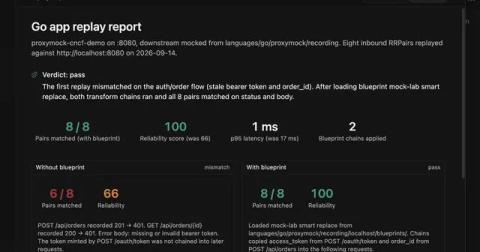
Use AI and traffic replay to test AI-generated code

When I ask an AI agent to change code, I also want it to run the application and test what it changed. Asking it to write some tests is a start. But if it invents the expected responses from the same assumptions it used to write the code, those tests can miss the same mistake. Traffic replay gives the agent something concrete to test against: requests and responses captured from a working application.

Why Mocks Fail at Scale #softwareengineering #devops #softwaretesting #api #aicoding

Mocking for testing starts off easy, but once you scale to multiple teams and AI agents, handcrafted mocks become a serious form of technical liability. Instead of treating mocking as an individual software engineering task, shift your mindset to treat it as a platform engineering task focused on automation and continuously refreshed modern data. Watch to see how adopting technologies like traffic replay to simulate realistic backend sandboxes can transform your modern testing workflow!

Ep 90 | Can AI Make Sense of Pharma's Messiest Data?

Human biology is extraordinarily complex, and researchers often have only fragments of information to work with. Brian Martin compares it to looking at a skyscraper through a keyhole: you can see something clearly, but only a tiny piece of the whole. Recorded at EVOLVE26 Singapore, this episode of The AI Forecast brings Paul Muller together with Brian Martin, CTO of Applied AI at Cloudera and co-founder of Rare Hopes NFP, to explore what one of the world’s most data-intensive industries can teach us about AI and decision-making.

Which AI Analyst Holds Up Best for Your Hard Questions?

Analytics vendors claim their AI answers questions accurately, but almost none of them will show you how they checked. The standard move is a percentage with no denominator: "90%+ accuracy on internal benchmarks." No dataset you can download. No scoring method you can inspect. No competitor runs under the same conditions. You're asked to trust the grade without ever seeing the exam1 We ran the exam in public terms instead.

Tideways 2026.3 Release

This Release introduces AI Performance Insights, expanding the Tideways CLI with access to monitoring, exception tracking, Slow SQL, and trace data for agentic performance analysis. We added PHP 8.6 compatibility and improved trace views and instrumentation. We’ve also added a broad range of new framework- and ORM-specific bottleneck detections for Shopware, Magento, Laravel, Symfony, and Doctrine.

Your analytics platform is part of your attack surface

Analytics platforms are built to help organizations understand what their users are doing. Increasingly, they do much more than that: they connect behavioral data with customer context, power personalization, inform automated decisions, and provide intelligence to teams and AI systems. To do this well, analytics needs access to valuable data. That makes analytics more than a measurement layer. It makes analytics part of your security perimeter.

Start your AI agent testing with deterministic tooling

By now everyone is aware of the limitations inherent in generative AI and the AI agents that use it to complete their tasks, and the challenges involved in getting them enterprise quality. If you are planning to incorporate AI agents into your enterprise IT architecture, how are you planning to validate their quality and accuracy?