We collect the latest Development, Anaytics, API & Testing news from around the globe and deliver it direct to your inbox. One email per week, no spam.
If your brand does not appear when buyers ask ChatGPT, Perplexity, or Google AI Overviews for recommendations, you are invisible to hundreds of millions of potential customers. ChatGPT alone now reaches 900 million weekly users. The shift is clear: buyers now get answers directly from AI engines rather than clicking through to websites.
Managing a $3 BILLION supply chain comes down to just 3 simple questions... @swirecoca-colausa6473’s VP of Data, Bharathi Rajan, reveals why you need to ditch the complex frameworks and AI hype before you try to scale. ThoughtSpot’s Cindi Howson drops the ultimate truth bomb: Stop waiting for "perfect" infrastructure. Use what you have today to win. Tune in to for the full blueprint! Music: “The Clermont” by Flash Fluharty Licensed via PremiumBeat, ID: P9IHFMDYNZCKLEFZ.
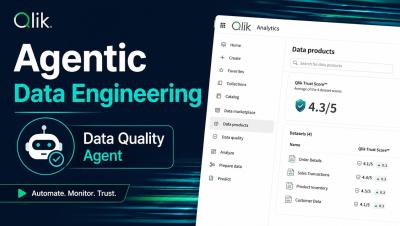
With the Data Quality Agent in Qlik, AI can guide data engineers through a full dataset quality assessment using natural language prompts. The agent can identify trusted catalog definitions, generate intelligent data quality validation rules, and provide transparent reasoning behind every recommendation.
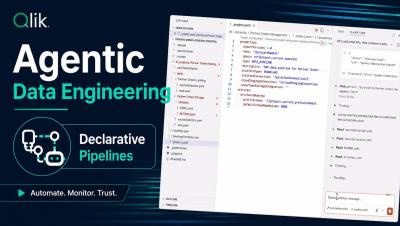
With Declarative Pipelines in Qlik, teams can use tools like Claude Code, GitHub Copilot, and integration with VS Code, to build and update Qlik Talend Cloud data integration pipelines using natural language prompts.
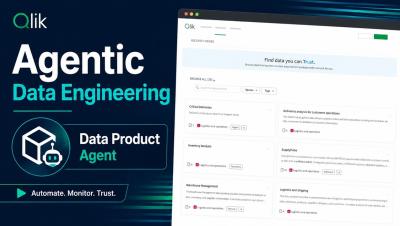
With the Data Product Agent in Qlik, AI can automatically generate curated Data Products using trusted catalog definitions, datasets and metadata. It defines the specification, contract, and reasoning behind the data, while also providing action confirmation before anything is changed.
Enterprise AI depends on data that was never designed for AI. Most business knowledge is not sitting neatly in rows and columns. It is spread across documents, emails, chats, tickets, logs, telemetry streams, PDFs, customer conversations, search indexes, knowledge bases, product content, operational systems, and digital experience platforms.
Your fraud detection system analyzes yesterday's transactions while criminals steal millions today. Financial institutions lose an estimated $33 billion annually to card fraud alone, much of it preventable with real-time detection capabilities. Traditional batch processing that analyzes data hours or days after transactions occur simply cannot keep pace with sophisticated fraud schemes exploiting the settlement window gap.
Every finance team managing multiple banking relationships knows the pain: downloading statements from six different portals, copying transaction data into spreadsheets, and spending hours reconciling figures that should match but don't always align. With businesses losing significant productivity due to manual data handling and delayed system synchronization, multi-bank data consolidation has become a critical operational challenge.
Hey, did you know your AI agents could be making decisions based on data they were never meant to see? When enterprise data governance is fragmented across separate tools, it creates severe blind spots. Rogue AI agents can over-index, modify, or even accidentally delete production databases simply because proper data guardrails weren't uniformly enforced. In this video, we tackle the root cause of why 79% of enterprise AI initiatives stall and show you how to build a unified data fabric that secures your hybrid estate.