Systems | Development | Analytics | API | Testing

AI Automation: Carving New Paths to Cost Savings, Innovation, and Competitive Advantage

AI automation involves leveraging artificial intelligence (AI) to automate repetitive tasks within operational workflows, thereby enhancing efficiency and productivity. This not only streamlines routine tasks within core business processes but also enables companies to scale growth efficiently by integrating a broad range of digital tools such as robotic process automation, APIs, and software robots.

Exploring 4 Impactful Examples of Using AI in Finance

For the banking and financial services industry, artificial intelligence (AI) isn't just a new tech trend. It's a powerful tool that will have a wide range of impacts, from risk management to operational efficiency and customer experience. According to Deloitte, the world’s top 14 investment banks could potentially boost their front-office productivity by 27% to 35% by leveraging generative AI.

Top Trends in AI for Federal Government

AI is emerging as an important tool for meeting the mission at federal government agencies. It can add efficiency and aid decision-making by: Many government agencies are already using AI processes. Below are some important use cases for AI in federal government: And that’s just a small sample of the ways federal agencies are using AI. Thousands more use cases have been identified related to national security, healthcare, transportation, and more.

Our product vision for analytics in the age of AI

Every winter, members of ThoughtSpot’s research and development teams participate in a company-wide hackathon called Codex. The ideas that come out of Codex are always inspiring, but the Winter 22/23 hackathon was special—OpenAI had just released ChatGPT and the world was buzzing about generative AI.

Achieving Trusted AI in Manufacturing

In the dynamic landscape of modern manufacturing, AI has emerged as a transformative differentiator, reshaping the industry for those seeking the competitive advantages of gained efficiency and innovation. As we navigate the fourth and fifth industrial revolution, AI technologies are catalyzing a paradigm shift in how products are designed, produced, and optimized.

A Data-Agenda at Davos: Promoting the Promise of AI

In the buildup to this week’s World Economic Forum Annual Meeting in Davos, Switzerland, the talk of polycrisis becoming permacrisis painted a picture of impending doom. These terms have been used to describe the global condition today, citing the “cascading and connected crises” triggered by war and geopolitics, economic uncertainty, and environmental concerns, and their persistence.

Top 3 Healthcare and Life Sciences Data + AI Predictions for 2024

This year may be the most innovative on record. Recent advances in AI are beginning to transform how we live and work. And the potential impacts of artificial intelligence (AI) on the healthcare and life sciences industries are expected to be far-reaching. It’s essential for organizations to leverage vast amounts of structured and unstructured data for effective generative AI (gen AI) solutions that deliver a clear return on investment.

AI and Privacy: 3 Things Leaders Should Know for 2024

In the rapidly emerging artificial intelligence economy, organizations will split into two groups: those who are good at AI and those who are bad at business. Most experts agree that AI won’t replace humans, but instead augment us in a world of mixed autonomy. You’ll need new structures to harness AI’s transformative potential while managing its very real risks—the biggest of which is data privacy. So how can leaders handle AI and privacy risks?

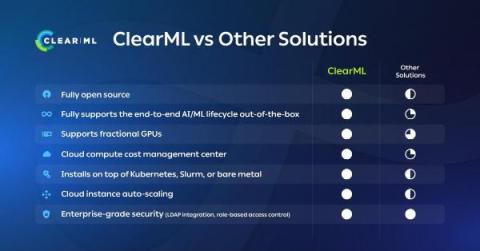
Easily Train, Manage, and Deploy Your AI Models With Scalable and Optimized Access to Your Company's AI Compute. Anywhere.

Now you can create and manage your control plane on-prem or on-cloud, regardless of where your data and compute are. We recently announced extensive new orchestration,scheduling, and compute management capabilities for optimizing control of enterprise AI & ML. Machine learning and DevOps practitioners can now fully utilize GPUs for maximal usage with minimal costs.