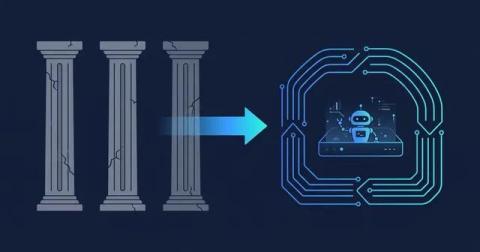
It was 2am and I was paying for the privilege. Something was on fire in production, and I’d done the modern thing: I pointed an AI agent at it. It ingested the dashboards. It read the logs. It walked the traces. Then it handed me back a beautifully formatted paragraph that said, in effect, “latency is elevated on the checkout path.” I knew that. The page told me that.
In 2006, the TIOBE Index crowned Ruby its Language of the Year for posting the fastest growth rate of anything on the list. Two decades later, it's settled in around - respectable, but a long way down from where it once stood. Ruby went from "the future of programming" to "wait, people still use that?" within a single career. This isn't a eulogy, though - stick around, because Ruby is very much alive, just not where the headlines are looking.
The gap between "our logs follow every best practice" and "I can actually find what's wrong, fast" is what I want to write about here. I'll go through the standard checklist first, because it's genuinely worth doing. Then I want to talk about the part that checklist doesn't cover.
There's a well-worn path to resumable AI chat streams: find the Vercel SDK docs, implement Redis-backed replay, and ship it. For many products, that's the right call. The challenge arises when the product goes further than that. AI customer support tools that handle complex queries over 30-plus seconds. Agents that keep working while the user switches from their laptop to their phone.
In 2024, two of the largest data platform companies, each with billions in revenue and dedicated AI research teams, invested in building their own foundation models. One spent roughly $10 million training a 132-billion parameter model on 3,072 NVIDIA H100 GPUs. The other released a 480-billion parameter model optimized for enterprise tasks like SQL generation and code. Both achieved strong results within their compute class.
Webinar recap: Andy Cotgreave (co-founder, How to Speak Data) and Francois Lopitaux (SVP of Product, ThoughtSpot) on hallucinations, accountability, and what it actually takes to trust AI with your data.
With the release of Xray Cloud 15.0.0, Xray expands its latest AI capabilities with the introduction of AI Test Prioritization, joining two recently released features: Xray's Rovo Test Plan Summarizer and AI-generated Manual Scripts for Test Case Designer, introduced in Xray Cloud 14.0.0. Testing is rarely just about executing test cases. Teams need to understand where risk exists, how testing is progressing, and whether a release is ready to move forward.
When you operate a digital commerce ecosystem across multiple international borders, processing thousands of concurrent checkout events for over 70 global brands, the standard concept of "QA" completely breaks down. Most corporate discussions treat software validation as a simple pre-release checklist, a final mechanical hurdle before a deployment goes live.