This article gives you an overview of Cloudera’s Operational Database (OpDB) performance optimization techniques. Cloudera’s Operational Database can support high-speed transactions of up to 185K/second per table and a high of 440K/second per table. On average, the recorded transaction speed is about 100K-300K/second per node. This article provides you an overview of how you can optimize your OpDB deployment in either Cloudera Data Platform (CDP) Public Cloud or Data Center.
So you’ve realized the benefits of test automation. Through your own research, or perhaps a small proof of concept, you’ve realized removing once-manual quality processes can accelerate release cycles and improve your user experience. You’ve built a small suite of tests, and the benefits are real. The next step in your journey, you realize, is to achieve the real value of automation, which means running it continuously and at scale.
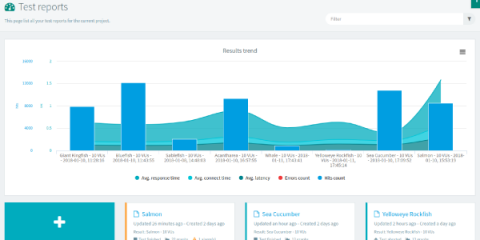
OctoPerf’s report engine provides many graphs to sort and presents test metrics in a comprehensive way. We’ve tried to improve it over the years so that you can access critical information very quickly. But requirements vary from one project to the other. In this post we will look at how you can configure the report to show you preferred metrics, and also all the shortcuts you can take to achieve this goal.
Powered by Fivetran (PBF) is a new offering for modern data insights platforms that provide analytics-as-a-service companies. These firms build data products on top of disparate solutions such as Tableau, Snowflake and Redshift, and offer insights to decision-makers in diverse verticals, from finance and marketing to energy and transportation.
In support of our partnership with AWS, we’re re-examining how some of our major customers today are using Kong with AWS. To this end, let’s look at our popular case study with Cargill. For over 150 years, Cargill has been on a mission to nourish the world in a safe, responsible and sustainable way.
As more and more data is exposed via APIs either as API-first companies or for the explosion of single page apps/JAMStack, API security can no longer be an afterthought. The hard part about APIs is that it provides direct access to large amounts of data while bypassing browser precautions. Instead of worrying about SQL injection and XSS issues, you should be concerned about the bad actor who was able to paginate through all your customer records and their data.
Today, we’re announcing Data QnA, a natural language interface for analytics on BigQuery data, now in private alpha. Data QnA helps enable your business users to get answers to their analytical queries through natural language questions, without burdening business intelligence (BI) teams. This means that a business user like a sales manager can simply ask a question on their company’s dataset, and get results back that same way.
As organizations look to get smarter and more agile in how they gain value and insight from their data, they are now able to take advantage of a fundamental shift in architecture. In the last decade, as an industry, we have gone from monolithic machines with direct-attached storage to VMs to cloud. The main attraction of cloud is due to its separation of compute and storage – a major architectural shift in the infrastructure layer that changes the way data can be stored and processed.